Canva Slideshow

Travelogue Slideshow by wayne rhodes

EATING IN PERU

Hola everyone,

By the time this is posted, we will be back in Chicago and Florida.  Here are some wrap- up perspectives.


Lima

We had a quick swirl through Lima, including a lovely lunch at the Cafe de Museo at the Larco Museum. The museum was fascinating and featured a 45,000 artifact private collection from pre-Spaniards' times. To correct an earlier post, the Incans were only in power in Peru for 100 years. Evidence of earlier civilizations has been found back to 3000 BC!! 

The collection included extensive erotica that rivaled the Kama Sutra carvings from in India. This is a PG blog, so I will say no more.  After the museum, we visited the requisite Peruvian chocolatier stop and then survived an absolutely unrelenting and harrowing ride (could have done without that) to the airport.


Eating in Peru

We enjoyed some high level cuisine in Peru (and they pride themselves on their prowess with fusion cuisine). Many of the themes from Ecuadorian dining are true here as well: beautiful fresh fruit and juices, the importance of corn and potatoes in the Peruvian diet...


...quinoa, fish (particularly Peruvian trout), and ceviche (though spelled here as sebiche). There are some distinctive dishes/drinks which we enjoyed here as well-- some clearly informed by the indigenous people's influence. Cuy (guinea pig, as described in the prior blog) was ubiquitous. We sampled Pisco Sours as our welcome drink at the hacienda. And I had two versions of a traditional Peruvian dish --"causa" --a terrine layered with mashed potatoes and meat.
On our first evening in Cusco, we dined at Cicciolino's-- highly touted by tour guides and the New York Times restaurant guide alike as a chic, upscale eating destination. It was literally 20 steps from our hotel. Though we were somewhat disappointed in the Time's choice for Quito, we took the plunge and we were thrilled we did. This was easily one of the best meals of the trip. We started with two salads -- I had a fresh salad of quinoa-coated prawns, mixed lettuce leaves and beet root chips dressed with a maracuya vinaigrette and plated with an exceptional mango and avocado tartar.

Monica and Betsy shared a fresh arugula, watercress and black quinoa salad tossed with fine slices of Italian Prosciutto and Salami, crumbled goat cheese, sweet tomatoes, radishes, red onion, corn, and a blue cheese dressing.  The presentation for both salads was exquisite-- as was the taste. 

The meal got even more interesting with the next course. Monica ordered a cracked pepper tagliatelle tossed through a salsa of smokey grilled chicken. It was absolutely beautiful.

Betsy ordered puttanesca pasta though described more artfully on the menu. It was truly divine. 
Maureen ordered risotto which, while delicious, was not as artfully presented as the other dishes.

I decided to go rogue and ordered Cicciolino's version of causa, so lovingly described as: "a fine layer of yellow potato mash with chillies and herbs, topped with deboned 'guinea pig confit'  with a touch of carmelized apple. The only way to try guinea pig."  When our guide heard I had tasted guinea pig confit, he was only slightly amused as the "real way" to taste guinea pig is to taste it roasted. To make a long story short, the presentation of my dish was amazing but the taste was not. Some say guinea pig tastes like rabbit; others insist it tastes like dark meat turkey. I was so hung up that I was ingesting a rodent that I could not really enjoy it. And (who knows if there was any connection), I started a regimen of Cipro the very next day. 
Dessert was a definite improvement for me: almond cookie tuiles with black sesame seeds, sweet mangoes and basil ice cream garnish.  Delicious.

Looking back a bit, our meals in Mach Picchu far exceeded normal national park fare. Indeed, Monica enjoyed spinach ravioli stuffed with corn cream and garnished with green apple salsa -- not a choice I'd make, but Peruvian gourmet.

Our Peruvian dining journey continued on our last day in Cusco with our traditional Peruvian lunch at the hacienda. We started with Pisco Sours and several of us chose the causa as an appetizer -- prepared with tuna instead of guinea pig, it was quite tasty.

I also tried a Peruvian soft drink-- Inka Kola-- tasted like cream soda with a funky color.

In Perspective

Powerful Peru:   A strong cultural heritage. The 5000+ year history of many indigenous peoples; it's definitely not just about the Incas. A thriving tourism industry that's getting stronger. The geography. The history.

Puzzling Peru:  Mach Picchu-- its mystery and mystique. Cuy-- who wants to eat guinea pig anyway?  And what is the deal -- Is it dangerous to visit Peru despite what their department of tourism says? (there were policemen on every corner in Cusco and much security at Machu Picchu.)

Poignant Peru: Mach Picchu--so moving. The llamas--so adorable. The children.

The title of the first post for this trip was "Exploring lands that time forgot " and that perspective was certainly uppermost in our minds during the entire adventure. After 10 flights, at least 12 boat rides of different sorts, several bus rides, and innumerable taxi and van rides, I must say that, with tourism being a major part of both Ecuador and Peru's economies, these lands are no longer forgotten. And we discovered they truly are fantastic. It seemed that I pinched myself (or was that a bug bite) five minutes into every Galapagos hike. And I certainly paused to catch my breath (or was that the altitude) after every third step in Machu Picchu. Even Roget does not have enough adjectives to describe the marvels of this particular journey. We were captivated by the big cities we had a chance to explore; but we will never never forget our explorations of the lands that time forgot.  What a glorious, amazing experience. Thank you  for joining me!

Before I sign off, I would be remiss if I didn't extend a huge thank you to my best friend and usual travel partner, Wayne. Thank you, thank you, love of my life, for not only enabling me to take this adventure but for being my tech support and turning my words and photos into this blog. Thank you for your patience with my late night blog entries and un-identified photos by the dozens!

To our dedicated readers: Start packing your virtual bags for our Ireland and London trip in June-- certainly not as exotic as this one-- but should be memorable nonetheless.

Everyone, be well and adios for now,

wendy


Welcome to Warsaw

June 8, 2012
Cześć! That's "hello" (pronounced "chashch") in Polish. Warsaw, Poland is the starting point for our 8th Tauck tour. Our destinations will include:  Warsaw, Bialystok, Tykocin (these latter two cities are where Wayne's family is from several generations back; we have secured a private driver for Saturday), Kracow, Budapest, Bratislava, Vienna, and Prague (sidetrips to Auschwitz and Terezin also will be included). 

We just arrived this morning so only have first impressions to report (and a meal, of course). Warsaw, which was decimated in the big War, has seen a renaissance--a good part of that due to the European Futbal Championships which started here today.  It's kind of how we imagine it will be when our beloved Cubs make it to the World Series.  

Our hotel is in the old section of town, right next to the presidential palace. And even the lions out front are showing their national spirit:

Everyone is wearing red and white and dancing in the streets (and this is only round one). Groups of young people, in Polska garb and face paint are everywhere.  The town is spotless; there are security guards all over; and lots of nonstop cheering (apart from the game) and random blowing of Polish-style vuvuzelas (the South African bugle equivalents).  As we write this, Greece is up one goal. As an aside, there has been a lot of coverage in the NY Times about the possibility of racist taunts toward the athletes.  Indeed one young man from Africa has made clear he will leave the field at the first sign of taunting.  It will be fascinating to see that storyline play out given that we are basically in the neighborhood of several of the worst camps from the War. 

But to something more uplifting.  Food.  Our first "meal" was at U Fukier (in the old town) a kitchy and wonderful traditional Polish restaurant (with food "like grandma used to make") in a restored 18th century home--with every inch covered--lace, flowers, portraits, and a singing bird in a cage (www.ufukiera.pl)  Even though this restaurant caters to tourists, we found it absolutely wendy and wayne write-up worthy (wx4)--as the pictures shown below depict.  


We started with some wonderfully hearty Polish bread--brown rye and oat bread, both served with a cucumber spread.  Next, Wendy had delectable smoked Polish salmon--served with red roe, capers, and edible flowers.  It was amazing.  Wayne chose the veal pirogi with bacon dust (we decided we're on the "pirogi a day" diet).  It was mouth watering and quite delicious.  For our main course, we shared half a roast duckling with stewed fruit; Wendy added brown butter crumbed white and green asparagus.  Why can we only rarely find white asparagus in the states?  (By the way, the menu touted that everything was organic).  We ended our first Central European meal with a warm apple tart--superior to any apple pie we've had in the states for a long time.

After dinner we took a carriage ride around Old Warsaw.  Our driver was quite informative--we think--(lots of buildings are apparently 1,500 years old)--but seeing that we don't speak Polish, we missed most of it. 

That's all for now.  We'll have another post before we leave for Cracow on Monday morning. 

love, 
w&w

Poland - Past and Present

June 9

The Tauck tour did not actually start until dinner tonight, so we used our free day (Saturday) to take a tour of the past.  What we mean is this: Wayne's grandparents / great-grandparents came from Bialystok (pronounced Be-ah-we-shtok) and Tykocin (formerly Tiktin, pronounced Ti-ko-chin) respectively. These towns are in northeast Poland, 3 hours from Warsaw. Wendy's great-gandparents came from Jaroslaw, which is 6 hours southwest of Warsaw. We had hoped to be able to visit all three towns, but the constraints of time and distance made this impossible. So we were only able to do Bialystok and Tykocin.

Our guide/driver picked us up at 7am and we headed out of town. Along the way she pointed to various churches, palaces, old walls, etc.  One of the neatest things was seeing many, many stork nests, most with a mama stork feeding her babies.  Apparently, Poland has the biggest number of stork nests in the world.  Who knew?  These are huge birds that migrate to Africa and return to the same nest (and the same mate) year after year. 

Our route, for the most part, was an updated, albeit two-lane highway.  So, our guide spent most of the time passing huge Russian lorries.  Kept us entertained and energized to say the least.  Our guide also filled us in on some of the pre-conceived notions about the Holocaust (at least from a Polish point of view).  For instance, many, many Polish Catholics were murdered in the Holocaust--President Obama's malappropism about the "Polish death camps" still stings in ths part of the world. 

As we were driving we realized that we are the first people from our family to return (so closely) to the actual towns where our ancestor had lived.


When we got to Bialystok we first went to the Palace Cytron, which is now the History Museum. We learned that Bialystok was originally a private city, a not uncommon thing in those days in Poland. The local rich person (in this case one Klement Branicki) owned the town and had a large palace in the center.  The townspeople lived around the palace, often according to their class.

Our guide then told us that Bialystok was the 3rd most destroyed European city in WWII (after Warsaw and Dresden). The building we were in was one of the very few left standing. So the city of 200,000 people has been entirely rebuilt since the war ended. Oddly though, much of the architecture is in the style of the 19th and early 20th centuries, so the buildings look old. The palace Cytron did have many relics (China, shabbat candles, etc.) that had been left behind and buried by Jewish famlies; some were discovered only in the last 10 years.

Wayne's relatives left this area in the early 1900s (when Bialystock was a part of Russia) with many of  the Jews who lived here when the situation started getting out of hand.   But many remained.   We learned about the uprising in the Jewish ghetto in August, 1943. Jews were brought here from other towns and eventually all were killed. We saw several memorials to those who perished--including monuments/plaques commemorating two synagogues. Bialystok is also the home of Ludwig Zamenhof, the creator of Esperanto...intended to be a universal language. It is still taught in several schools there.

Then we drove about 20 kilometers to Tykocin.

There is not much in Tykocin (population 2,000) except the old synagogue built in 1642. Indeed, as we pulled into town there was a tour group headed there. Just as we got there it to started to pour, so we went int a restaurant for lunch.  It was good Polish food, nothing memorable, except for a page on the menu: the "Jewish Cuisine" page which incuded (among other things) kugel and kreplach! Hey...a dumpling in any language is still a dumpling!!!! Today, one of the flavors was mushroom and cabbage.

The rain stopped as we finished eating, so we went to the synagogue. It had been partially destroyed by a fire in the 1700's, but was rebuilt. The ceiling over the bima is painted in Renaissance style artwork which can still be seen today. It was used as a storehouse by the Germans during the war (probably because it was the biggest building in town), and they had to leave quickly as the Russians approached...so that's why it was not destroyed. Many of the original wooden shtetl houses from 100+ years ago still stand.


It was very surreal to be walking in places so far removed in time and distance and lifestyle from the people who lived there...our relatives...over 100 years ago. What drove them to leave their homes for the unknown of the U.S.? Was it an easy decision or a hard one? Did they ever regret it? Who stayed behind?

It is sobering to think that if they hadn't left, we probably would not be here to write this today.

To learn more, check out these links:

-----------
Other things we learned/ observed:
Poland is the third largest grower of strawberries in the world, and this is the peak of the season. They are truly delicious.

Cigarette smoking still seems to be very popular in Poland. We have seen many people of all ages smoking.

Our hotel, the Bristol Meridian, was one of the few buildings in Warsaw to survive the war. It is a historic hotel for another reason: it was built (in 1905) by Jan Paderewski, the very famous pianist, who was also a president of Poland!   And...it turns out that this is also where the Russian soccer team is staying, so there are extra extra security people everywhere. You see, the Poles and Russians have not gotten along well with each other since, oh, the late 18th century. Hopefully there will be no incidents (especially while we are here), and that the match next week will go smoothly.

As you invariably have noticed there were no w&w worthy food write-ups from Saturday.  We will save those for outstanding meals. 

That aside so far, the touring has been interesting and poignant.  Today, we tour Warsaw including  the ghetto area.

All for now and love,
w&w.

Warsaw and Krakow

It's been a busy couple of days!

Sunday morning we took a bus tour of Warsaw. The first stop was the Royal Kazienki Park, which is dedicated to and has a huge statue of Frederic Chopin (and a smaller one of his friend Franz Liszt). Chopin is a French name...his father was French and his mother was Polish, and he was born and lived in Warsaw (also in France). This statue, like many others in the city, was destroyed by the Germans in the War, but has been completely replaced down to the last detail.

Speaking of Polish-French, we later passed by a museum dedicated to Marie Curie - nee Skladowska - who was also born here.

And speaking of statues, they sure have a lot of them! (or perhaps it was just that our tour went by all of them!). These include Copernicus (who studied here), Kosciusko (Polish and American war hero), Pulaski, and Reagan. That's right: old Ronnie is here commemorating his help with Polish independence from the Communists. Our guide said there are also statues of George Washington and Herbert Hoover (?).  And many, many war-related memorials: Tomb of the Unknown Soldier, Monument to the Fallen Heroes, Memorial for the Warsaw Uprising, etc. How about a monument to no more wars????

Next we went to a Jewish Cemetery that has been in existence for hundreds of years. Per tradition, women are buried in one area, rabbis in another, wealthy people in another, etc. It also has the tomb of Zamenhof (see previous post), and several war memorials. One is of a pediatrician, Janusz Korczak, who ran an orphanage. When the Germans came to take the children, he went with them to his death. (More at http://www.inyourpocket.com/poland/warsaw/The-Korczak-Orphanage_71959f )


We then went to the area where the Jewish Ghetto was and heard about the huge number of people crammed into a small area, and the Warsaw uprising, and the eventual removal of all the people. Truly hard to fathom how this could happen.

The tour ended, so it was time to eat again. We found a great outdoor cafe (one of many) and had wonderful veal-filled pierogis, prawns in garlic butter (prawns seem to be a big thing here), and of course, beer. [An aside: 2 different guides have told us the same story: "If you go to a Polish restaurant and they don't serve pierogis, it's not a Polish restaurant!"]

After lunch we walked around some more (and walked off the pierogis), saw more memorials, and then rode the subway. Of course we stopped for "ludy" (one of the few easily pronounceable Polish words..it means ice cream). The Poles love ice cream and there are several walk-up ice cream windows on almost every block. Apparently they also love bagels as there are hot bagel vendor carts on many corners.

Speaking of the language, our local guide told us a tongue twister...something about a bug in the grass. It goes like this: chrzaszcz brzmi w trzcinie w Tszebrzeszynie.  Go ahead...say it 5 times fast!

Later the group was treated to an amazing private performance: A Chopin recital by world famous, award-winning pianist Maria Korecka-Soszkowsk at the Palace Myslewicki (read more at
http://polish-landscape.pl/gb/our-pianists ). This woman, who is in her 70s, played 7 Chopin songs (and an encore by Paderewski) on a grand piano in a small salon room. It seemed at times that she had at least 4 hands. This was how Chopin intended his music to be heard, as opposed to Liszt who was a concert hall rock star. Remember, it's only been a little over 100 years since the time when, if you wanted to hear music, a real person had to play it! How utterly foreign in today's instant download digital world.

Yesterday we drove to Krakow. Took a short walk around the medieval town square (a beautful  European town square that was not bombed by the Luftwaffe in WWII--because the town was of no strategic military significance nor was there any resistance during the Occupation).


Got to our hotel and once again there were a lot of security people around. Why? The Dutch soccer team is staying here! (The Eurocup games are in Warsaw, Krakow, two other Polish cities, and two cities in Ukraine).

Then we took a tour of the Wieliczka Salt Mine, a UNESCO World Heritage site. ( http://en.wikipedia.org/wiki/Wieliczka_Salt_Mine ). This mine, which operated from the 13th century until a few years ago, goes to a depth of over 300 meters (we only went down to the 130 meter level) and has tunnels and caverns covering 190 miles (about the distance from here to Warsaw!).  If you wet your finger and rub the wall and taste it you can actually taste the salt! It is a constant 52 degrees inside (quite pleasant actaully after the intial descent of 400 steps!). It also contains a sanitarium for people with asthma and other bronchial diseases. They live down there for a week, a month, or longer in the belief that breathing the salt air will help their condition.

There are many underground salt pools. The tour stops at various "rooms" (ranging anywhere from niches to a cathedral-sized one where they actually hold concerts and weddings!). Each had one or more carvings made out of the salt rock: miners, horses, the Last Supper, religious figures including Pope John Paul (who grew up here),....even miner gnomes!!!! All told we walked 2.5 kilometers and traversed 800 steps! Luckily, there is an elevator to the top.....well...it is a miner's cage measuring 3' x 4' by 6' high and all 9 of our group were stuffed into it!


So far, the tour has had a heavy slant on what happened during WWII. The war ended 70 years ago, which means 3 or more generations...a long time, yet a blink in history. Many people are alive who still remember the horror and suffering. But we wonder if this is the framework around which the current generation defines itself. To them, is it history or is it still an integral part of their lives?

Today we had the Jewish heritage tour plus Auschwitz--needless to say, we are drained so will save those write-ups for the next post. On to Budapest tomorrow.
-------------------------
Other fun facts:
Cranberry juice has apparently not made it to here yet. Instead, they drink black currant juice....tart, but not bad.

We Americans think of this area as "eastern Europe", but it really is central Europe, as there is a lot more east of here (check the map!). Once again our provincialism surfaces.

Apparently, anything can be used to fill pierogis: any kind of meat, potatoes, cabbage or other veggies, and then the sweet kind filled with fruit. And when you order them, you get 10 - 12 ravioli-sized pieces. Who do they think can eat all that?


love,
wendy and wayne


Traces of Memory


In our last post, we implied that we needed some distance before we could post our report from Tuesday—when we spent the entire day on the Jewish heritage of Central Europe.  First, we had a Jewish heritage tour and then we visited the Auschwitz Memorial and Museum.  Indeed, we needed a full two days’ distance before we could summon up the emotional fortitude to write this post. And we are still processing.  But, in the spirit of moving forward with the rest of the trip, we’ll do the best we can here.  Please understand that the post is more about impressions and feelings than “what we saw” per se.

As context, the Jewish people comprised a significant minority population in Central Europe for over a thousand years.  Poland, in particular, was the home to many vibrant Jewish communities for centuries.  Those communities were characterized by memorable synagogues and enclaves in both major cities and small towns. Indeed by the early 1940s, Jews comprised approximately 10% of Poland’s total population (this compares to a one digit percent of Jews in the States today).  This data was staggering to us.

I would imagine that nearly every medium to large city in Central Europe offers some sort of Jewish Heritage Tour these days.  The purpose is to “showcase” where the Jewish communities and synagogues were located “in the day” and to demonstrate how they are coming back. This is aspirational because, in most cases, both the residents and evidence (buildings, synagogues) of those communities were completely decimated in the Shoah so there is very little to see in these tours—an archway here, a few bricks there, a trace of a cemetery there, and many memorial plaques everywhere.  So, the tour of Krakow was disheartening (though that was expected).  We saw a tiny 18th century Orthodox synagogue being rebuilt (the townspeople completely covered up the cemetery to protect it from Nazi destruction and it is still being renovated).  We saw a remnant of the ghetto wall.  But, most unforgettable was a remarkable exhibit “Rediscovering Traces of Memory” at the Galicia Jewish Museum - see www.galiciajewishmuseum.org. (Galicia is the southern region of Poland that includes Krakow and the town of Jaroslaw, where my (Wendy’s) family emigrated from in the early 1900s.) The photographer tried to capture the essence and historical arc of the Jewish community of Southern Poland before, during, and after the Shoah through post-Shoah photos (only photos showing groups marking Holocaust Remembrance Days included people).  For instance, he photographed synagogues (and/or their remnants) throughout the region. He juxtaposed memorials in forests where there were mass executions with solitary signposts. Perhaps most poignant for me was a photograph of gravestones from a Jewish cemetery that had been repurposed as sidewalk blocks.  The exhibit was powerful and terribly sad. I truly had a visceral reaction to the loneliness, desecration, and sense of ruin portrayed in photo after photo.

(To learn more, refer to "Rediscovering Traces of Memory", by Jonathan Webber)

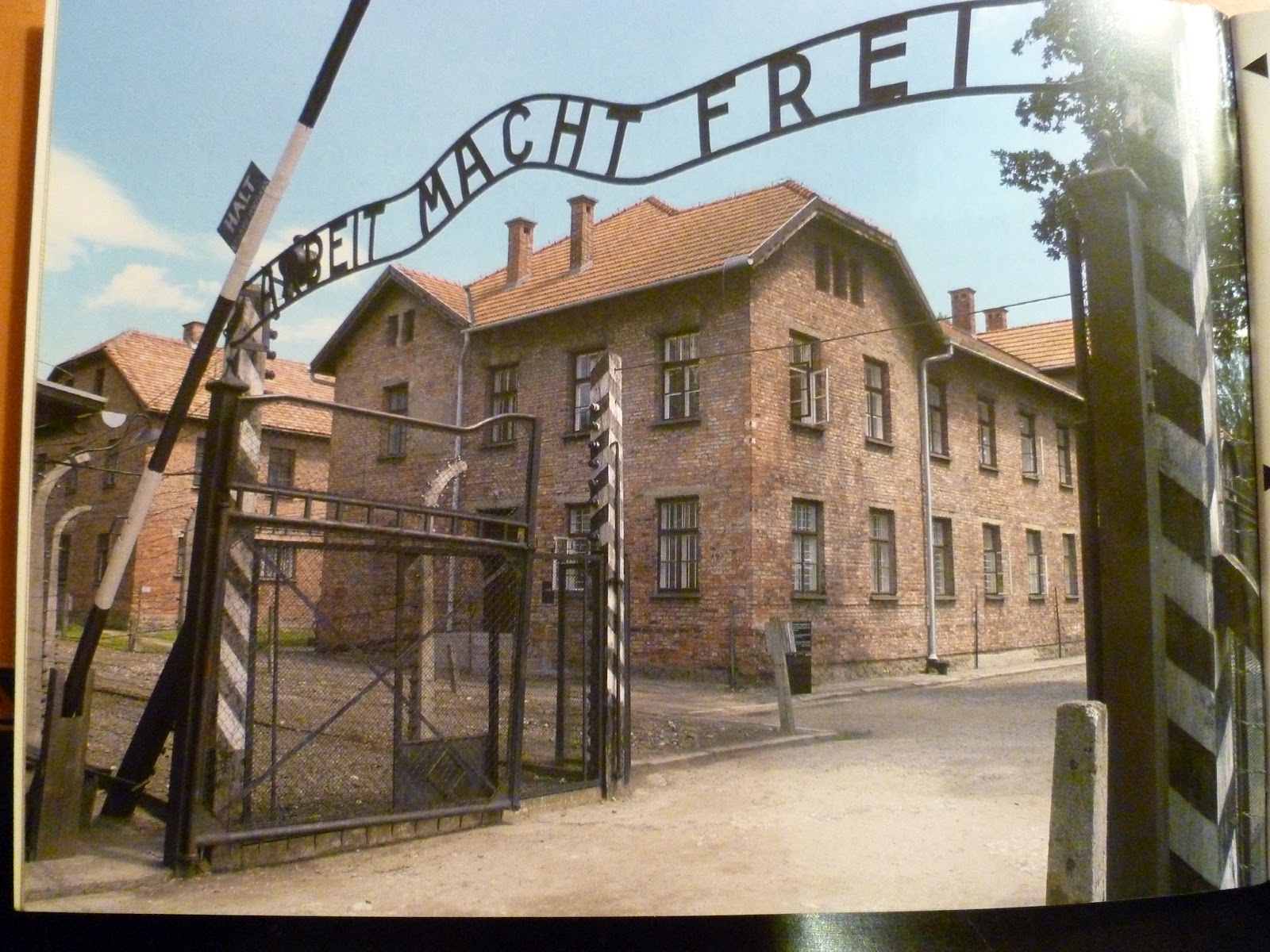
So, needless to say, I dreaded the afternoon visit to Auschwitz.  But, given my experience visiting other Holocaust museums around the world, seeing movies (like most of us), and reading more fictitious accounts (from every possible nationality) than I can count, my reaction was completely different than I expected.  Of course, it was surreal to be there.  And there were displays that were shocking.  Seeing the sheer size of Birkenau took my breath away.  And I certainly gasped at the entry way to the camps.  But, overall, I felt like I was on a terrifying horror movie set.  I knew intellectually what happened there, but—during my visit—I could not accept it emotionally. I felt like I was visiting a death factory—a fact that seemed reinforced by our (what I believed to be) melodramatic, yet clinical, guide.   The people in the photos (upon arrival at the camps) looked so normal—they could have been my great grandparents, my grandparents, my parents, family friends.  I could not and still cannot allow myself to wrap my heart around its enormity. And the sign over the gate, translated as “Work Makes You Free” is one of the most heinous lies in history.   


I know we try to make our blog posts upbeat and fun—full of amazing meals and exciting adventures. This past Tuesday was not one of those days and this has not been one of those posts.  It truly gave me solace to recite both the Kaddish and El Molei Rachamim (the prayer for the dead) in the barracks at Birkenau with new friends.  We must never forget.


We arrived in Budapest on Wednesday late afternoon and have had a truly magical time, with many fun adventures, so far.  Tomorrow brings Kabbalah Shabbat Services at the glorious Doheny Synagogue followed by a foodies’ delight dinner.  So, we promise that the subsequent posts will be more uplifting.

Love,
wendy and wayne

Goodbye pierogis, hello paprikash!

Wednesday was primarily a travel day. We left Krakow early in the morning for an 8-hour (total) bus ride to Budapest. From Poland we crossed over into the Slovak Republic. Because both countries are in the European Union, the border crossing is a non-event. We ascended to 4,000 feet as we crossed the Tatra Mountains, then stopped for lunch in the small village of Banska Bystrica. NOTE: All meals for the last few days will be described in a subsequent post. This post will just whet your appetite!  Then it was back on the road until we got to Budpest around 4pm.

For those who don't know it, Buda and Pest ("Pesht" in the Hungarian pronunciation) are two separate cities divided by the Danube River. The Buda side is hilly and primarily residential, while the Pest side is flat and has the business district and the government buildings, as this is the capital of the country.

Speaking of pronunciation, our guide told us that there are no exceptions when pronouncing letters in the Hungarian language (Wayne's ESL students must be jealous of that!)  So, he said, after a 5 minute lesson you can read any Hungarian book perfectly. Of course you wouldn't understand any of it! The language has no resemblance to any other European language! Some think it is related to Asian language groups as that is where the Magyars (the real name of the people) came from. "Hungarian" is a version of "Sons of the Huns" because people thought the Magyars were related to that Atilla fella.

Once we arrived we took a short walking / orientation tour in the area around our hotel. WOW!!!! What a beautiful city!!! It has a long history but the current city (as it stands) only dates back to the 1850s; the Danube flooded and basically destroyed everything. So it has been completely rebuilt and heavily modeled after Paris. In fact, many of the buildings were designed and built by the Eiffel Steel Company. It has that same 19th century, heavily ornamented, 4-story look. Of course, the ground floors are now all filled with 21st century shops (Fact: the first and only McDonalds to operate behind the Iron Curtain is here!).  However there are many Communist-era buildings - you know, those gray, utilitarian monoliths. Our guide described the style as Stalinesque-grotesque.

Wednesday's meal was a dinner cruise on the Danube! A violin player serenaded us with lots of favorites including, of course, the Blue Danube Waltz, and finished with the Radetsky March, which is always the last song played at the New Year's Eve concerts in Europe. It's a real crowd pleaser! Details of the meal itself to follow.

Thursday we took the real tour of the city. We first visited the Opera House, a magnificent building.


It was the first air-conditioned building in Europe, using a series of ducts that pulled cool air from the riverside underneath the floor and up through vents beneath each seat. Our visit included a "surprise" serenade on the staircase by a tenor who sang 3 of the most popular arias in the operatic canon.

Next we went to Heroes' Square which was built in 1896 to celebrate the 1,000th year of the country. Our local guide, Balant, told us that Hungary is the only country in the world that is completely surrounded by itself. What he meant was, Hungary used to be much larger, but over the centuries it has been occupied and overrun and chopped up. So now, no matter which way you leave the country, you still cross over into land that was once Hungary's.

Certainly there was some typical tour guide shtick, but Balant said the real first language of Hungary is "sarcasm". This was a mechanism the people used to survive 45 years of Communist rule ("We welcomed the Russians in 1945 because they chased out the Nazis; unfortunately they liked our country so much, they stayed for 45 years").

Then we toured St. Stephen's Basillica. St. Stephen was the first king, in the 1100s. Apparently he is still a big deal here (e.g., there was also a statue of him in Heroes Square). Inside we saw his mummified right hand! Lore says it spontaneously mummified (and a full battery of tests a few years ago in the U.S. found nothing to disprove this), so it was accepted as a genuine miracle.


Later in the day we toured the Dohany Street Synogoue.  Built in the 1850s, and seating 3,000 people, it was, for a long time, the largest synagogue in the world; now it is the third largest.
(See http://en.wikipedia.org/wiki/Doh%C3%A1ny_Street_Synagogue ). This is certainly the largest synagogue we have ever seen, and the ONLY one with an organ and pews! Our tour guide at the synagogue, Agnes, was convinced that she is Wendy's distant cousin (on the Baron / Cohen side). And we did see a slight resemblance!


Outside the synagogue was a beautiful memorial garden dedicated to the Righteous Heroes, those non-Jews from Budapest who risked their own lives to save the lives of many Jews (though 400,000 Hungarian Jews did perish in Auschwitz). Some of these heroes were also killed by the Nazis.

Next, we took the subway to the Szechenyi Bath and Spa ( http://www.szechenyibath.com/ ). This large public "pool" actually contains 14 different pools of varying sizes and temperatures. Some were indoors and some were outside. Wendy and two new Tauck friends checked them out....it was amazing and super fun!


For dinner we went to the Hungarian restaurant Dio (which means "nut"), a local favorite.  Stay tuned!

Friday was another tour of Pest and then over to Buda. We started with a drive by the river where we saw the Shoe Monument. This is 50 pairs of (iron) shoes symbolizing the 50 Jews lined up and shot and thrown into the river in the ending days of the war. While Budapest was heavily bombed (by the Germans, Russians, and U.S.) it did not suffer as much damage as Warsaw or Krakow.

On the route we passed through a square which had two signs: one contained the current name of the square. The other said "Roosevelt Square" with a red line through it. Huh? What's that about? Well, the square was actually named by the Russians as a way of thanking Roosevelt for his help in dividing up Europe. So when the Reds were ousted in '89, the Hungarians x'ed out the old sign and renamed the square.

Next we went to the Hungarian Parliament building, one of the largest such buildings in the world. It is truly huge and magnificent. The square in front was the site of the 1956 Hungarian "uprising", which (per our guide) was largely instigated by the Russians as a pretext for staying longer in the country. The photo below shows only a small section of one wing of this building! And talk about ornate! This place makes the Opera house look shabby. In the middle, under the huge dome, protected 24 hours a day by two sword-carrying soldiers is, you guessed it: St. Stephen's crown.


Then we finally went over one of the city's 7 bridges to the Buda side and the Buda Castle district. We saw the beautiful Matthias Church, and we were lucky to get in as it is periodically closed due to the ongoing major renovations (reminded us of Sagrada Familia in Barcelona!). Also at this site is the Fisherman's Bastion, built only a few years ago to honor the fishermen of the area, but mostly as a platform for a beautiful tourist's view of the Pest side of the river.


Then the bus took us back over the river to a large market. As with ones we've seen in other countries, this was filled with butcher stalls, fish stalls, and many vegetable stalls. Unlike many others it was bright and clean and relatively odorless. Of course, it had local things like paprika stalls and strudel stalls (which, we were surprised to see, also sold challahs).


The mile walk back to our hotel was on a pedestrian-only street filled with beautiful buildings and lots of merchants and sidewalk cafes including this one with food to die from:


At 6pm on Friday we went back to the Dohany Street Synagogue for Kabbalat Shabbat.  What a fascinating experience!  The synagogue, a hybrid of Orthodox and Conservative, requires men and women to sit separately. Everyone was so warm and welcoming when we came in—Shabbat Shalom means the same thing in Budapest as in Highland Park.   Of course, head coverings are required for men but many (including Wayne) were wearing baseball caps (there were no kipot available for use); so Wayne felt right at home! We made sure to each pick up a siddur (prayer book) but they were written primarily in Hungarian—a fascinating way to display transliterated Hebrew.  As mentioned earlier, there was an organ and at least two chazzan (cantors).  Their chanting was magnificent and Wendy was quite sure that one of them hit a high G—no straining!  Another interesting phenomenon was that on the women’s side, there was very little attention paid to the service—just a lot of kibbitzing.  At least 100 worshippers were in attendance—representing a broad age span.  Most touching, perhaps, was that several of them seemed to be Dohany regulars.  One gentleman, in particular, must have been in his 90s.  How powerful to have survived the Shoah and be able to continue worshiping in your own shul.  For the most part, the melodies were unfamiliar but we tracked with the structure of the service and certainly recognized and participated in the Sh’ma and Kaddish prayers and understood the choreography during the l’cha dodi. They did the Kiddush mid-service and two gentlemen passed around tiny plastic cups of wine.  When it was time for the sermon (in Hungarian), Wayne and I discretely stepped out.  Hopefully, the Rabbi was not talking about kindness to strangers.  This was such a memorable and meaningful experience!

For our last night in Budapest we had an absolutely divine meal at Onyx. Tres chi chi! Yes...food really to die for. But you'll have to wait!!!!

Next: on to Bratislava and Vienna!
------------
Things we've learned:
Just because a country is in the EU does not mean it is on the Euro. In fact, only 12 of the 28 EU countries are!

So far we have ridden the subways in Warsaw and Budapest. The Budapest subway is actually the 2nd oldest in the world (after London's)!!! While it got the job done, the trains and stations do look much as they must have when it opened in the 1890s.

We had expected the beers to be dark and heavy, but to the contrary they have all been rather light-colored and mild. We shall see what Austria has in store.

Only recently, two new laws were enacted in Hungary. First: no smoking in all public buildings! This looks like it will be a big change for these folks  Second: no jaywalking! Our guide said there is a $100 fine and that the police really are citing people. Yikes!

OK, help us out here:  these people eat all this heavy food and drink a lot of beer, but we have yet to see an overweight Pole or Magyar! What gives????

love,   w&w.....

And so we ate…. In Budapest

This has been such a powerful trip so far, it just doesn’t seem right to mix food observations with broader perspectives.  So, we’re separating them.

Big tastes first… this is the height of the strawberry season and they are red and so deicious.  The food is heavy (though due to Tauck guests’ feedback, they have added vegetarian options throughout, thank goodness!).  Everyone knows about the pastries in Europe (particularly Hungarian and Viennese).  But, we certainly weren’t aware of the prominence of ice cream concoctions.  Think the biggest sundae imaginable with extra scoops and toppings and more elaborate and you will begin to understand these delicious works of art!   Only ordered it once but, more to come! Lots of pork, lots of duck, salmon (mostly smoked and outstanding), scampi several times.  Oh, can’t forget the bread.  If you are on no carbs, you are in trouble.  The Kempinski restaurant in Budapest actually had a wall of bread.  And, while we did not sample them all, what we had was fantastic.  Finally, local beers are amazing and we think Wayne has sampled them all so far—and the steins are large!
OK.  Now the specifics.  Our first meal in Budapest was on the Danube river cruise.  We are not big fans of buffets but this one was lovely.  Particularly memorable was the veal goulash with light and airy spaetzle.  Very delicious in small quantities because the dessert was displayed close by.  Among other pastries, the introduction of strudel!  Oh my.  In this particular meal, it was cherry strudel, but since then we have had apple and chocolate.  So flakey, so buttery, so delectable.  The cardiologist we were dining with went back for thirds and new friends have been popping Lipitor like there’s no tomorrow!

Next meal of note… lunch on Thursday.  We were still stuffed after the grand buffet, so stopped for a bite at Gerbeaud (a Budapest open-air art deco café since the 1850s).  Our meal was not significant in terms of quantity—we both had salads (ah, nice to be in Europe where it is completely safe to eat greens ); a new friend had a beautifully constructed smoked salmon tower on an exquisite split mini-loaf of multi-grain bread.  But the dessert (ordered by one of us in our family—guess who) was the piece de resistance.  Ordered to satisfy an urge for one scoop of vanilla with hot fudge—it was four scoops with not only hot fudge but spectacularly designed whipped cream, sponge cake and two chocolate cigars.  Self-restraint was not really in the cards.

We had vowed there would be no dinner.  But, alas, that was not to be.  We headed over to Dio (which means “nuts” in Hungarian, which we were to eat another meal, but we went anyway).  Fantastic!  We did decide to limit ourselves to two courses, not including the delicious bread of course, with butter so creamy and delectable you could eat it with a spoon (after smearing it on your hips).  Wendy chose the breast of duck with Tokai wine and date barley risotto—the duck was superbly succulent and perfectly sliced and arrayed across the risotto. 

It was accompanied by a plate of beautifully grilled vegetables which we had requested.  (We originally asked for cabbage but the chef informed us it wouldn’t be appropriate—in other words it would “compromise the integrity of the dish.”)  Wayne ordered the paprikash veal stew with egg noodles (because you can never have enough goulash in Hungary!). It was delectable but the translation of “noodles” wasn’t quite right as this was more like a puffed egg soufflé then noodles per se. 

We ended the meal with chocolate strudel served with blackberry mousse and cappuccino.  (By the way, the cappuccino/coffee course is served separately.  As our guide informed us, once you have a table for dinner, it is yours for the evening.  The coffee course enables you to stretch that out and is generally accompanied by additional sweets.)
Friday, was the day of our “wow” meal in Budapest (not that the preceding meals were shabby). After Kabbalat Shabbat services, we treated ourselves to dinner at Onyx restaurant.  The “most famous” restaurant in Budapest (and also reputed to be the most expensive), Gundel is located next to the zoo and owned by the Lauder (as in Estee) family.  We purposefully chose to bypass that restaurant for Onyx which had been touted in the NY Times best restaurants in Budapest post (frequented more by locals than tourists).  It was truly a special meal.  The room was intimate (12 tables—30 guests) and the service wonderful.

Wendy started with Tokai sparkling wine “The Royal Court”” Kiralyudar 2009 and Wayne had, yes, a beer.  This was a meal of countless courses—starting with an amuse-bouche of miniature chilled tomato soup accompanied by a stacked canapé of watermelon sliver, feta, and sardine adorned with a miniscule square of balsamic vinegar gele and a wisp pureed of tapenade.  For the next course, Wayne had  “bean soup” (sic) with langoustine and bacon—this was more like an simplified bouillabaisse but was tasty--regardless of the name.  Wendy’s next course was several spears of grilled white asparagus garnished with a simple (yeah, righ) bergamot sabayon.  Very delicate and delicious. Accompanying this course was the first round of bread.  A bread “sommelier” wheeled over a cart allowing us to choose from among all or several of the following:  multi-grain bread, parmesan cheese crisps, Hungarian white bread and an assortment of focaccia puffs (“pog’csa”) including, but not limited to these flavors:  beetroot, bacon, cabbage, and olive. They were all extraordinary—and I say this from experience—accompanied by that creamiest of butters again (pork pate and cottage cheese were the other choices.)

OK, moving to the mains.  Wayne chose tenderloin of beef with ravioli stuffed with confit shoulder of beef serve with goulash jus.  This was, by far, the best steak either of us had ever eaten.  Upon inquiring whether it was from Hungarian beef, we were told “no, it’s from the United States.”  LOL, it was great. 


Wendy had sole with lemon mousseline, carrot textures (this is directly from the menu, folks), pistachios, and clam sauce. The carrot textures component was a swath of pureed carrot with different shapes and presentations. It looked like a little carrot town! The combination was light and extraordinary.

Palate cleanser next—elderflower granite with essence of grapefruit foam.  Doesn’t everyone?

We had to have dessert and Onyx did not disappoint.  Wayne had Tainori chocolate, violet—an amazingly configure chocolate fantasy including chocolate mousse, a chocolate cookie coil, and a chocolate ice cream cigar. 

Wendy chose a 21st century take on the classic Somlo sponge cake—a beautiful brandy snifter with layers of dark chocolate, white chocolate, milk chocolate, chocolate cookie, and whipped cream. 

Mere mortals would have been done by this point; but Wendy noticed that those who ordered coffee also had a cookie cart.  So, with my decaf (why bother) cappuccino, I had a choice of at least a dozen different cookies (no limit)—two types of exotic macarons (including poppy seed), several 21st century Gerbaud delicacies-chocolate/walnut/apricot concoctions—almost too beautiful to eat. We could go on.

Suffice it to say, our meal at Onyx was truly memorable and, luckily, we’ve done a lot a walking the past two days in Bratislava and Vienna with more walking to come because those calories need to be burned…but it was so worth it.  I could say we will never eat again, but that’s simply not true!

Love,

wendy and wayne