Canva Slideshow

Travelogue Slideshow by wayne rhodes

Broadening Our Perspectives - Part I


As I write this, it is early Friday morning and we are flying over the Labrador Sea toward Newfoundland on our way to Newark (where we'll connect for home). In the event our perspectives and imaginations hadn't been stretched and twisted up until this point in the trip, that stretching and twisting took on new shapes as we began to wind down for our departure.

A few words back to our speaker on Tuesday morning. As I wrote, she was a councilwoman in the Jerusalem city government. Yes, she represents one of the far left parties and they are definitely in the minority-- but her words gave me hope. She articulated the three major challenges facing Jerusalem (as a microcosm of Israel): 1) rich/ poor, 2) Palestinians/ Israelis, 3)  across religious groups. If you think of Israel as a very detailed, intricate tapestry with many threads and patterns converging and diverging, that's it. Extraordinarily complex. For instance, many of the ultra-Orthodox (Israeli) Jews are very poor. They don't send their children to the public schools (and this is sanctioned by the State), so they don't build marketable skills, and as a result, they cannot or will not work and, as a result, receive financial support by the State-- with an allowance that increases per child. These individuals have no interest, whatsoever, in sharing (or exploring the possibilities of co-existence) with the Palestinians (indeed, our speaker described this group as racist). So, the cycle continues.

When our speaker was asked what she thought President Obama and the U.S. should do, she responded that we should dish out some very tough love (my words) to Netanyahu. Not to get political here (but I will), but we need very strong leaders (with immense amounts of intestinal fortitude) to address the conflict and it just isn't happening.

On Tuesday afternoon, some of us headed back to the Old City for some retail therapy-- where we entered through the Damascus Gate. 


Those are spices stacked into a pyramid!
We were successful on that point-- but here we were exposed to the rough and tumble elements of Jerusalem. One member of our group was jostled to the ground and his cell phone was stolen. Another member was hit by one of the large, unwieldy, fast-moving rolling carts . She needed stitches in her leg. So the perspectives' broadening continued.

On Wednesday morning, we headed north toward Haifa with planned stops at the Sea of  Galilee, Capernaum, and Safed / Tzfat.  First, we took a boat ride on the Sea of Galilee. (Emily stayed behind to try her hand at "walking on the water".)
For many of our group, this was the most moving experience of the trip as this was where Jesus actually walked. Our ride was lovely and became part of the dual narrative when Yuval exuberantly initiated an Israeli dance-- several of us joined in. The skipper played the Star Spangled Banner at the outset and raised the American flag. While the flag of  Israel was also flying on the mast, there was no Hatikvah played-- perhaps out of political correctness and respect to Husam? This was one of those painful "dual narrative" moments (more on that later).


Our next stop was Capernaum, where Jesus lived and healed Peter's mother. The old synagogue (circa 4th century AD) was remarkably well preserved. 


Next, we journeyed to Safed / Tzfat, a Palestinian city taken over by the Israelis in 1948 that has become a center of Jewish mysticism (through Kabbalism), an art colony, and a retreat for the 1960's hippies' spirit.


We saw all three of these influences converge when we visited David Friedman's art studio. David made Aliyah over 30 years ago from Denver and acknowledged that the music of the Grateful Dead (plus the drug culture) influenced his art. His works are stunning and reflect many Kabbalistic elements, which he beautifully and spiritually spelled out. Many in our group were moved to purchase his artwork (your writer among them).   


After the time at David's studio, we visited a stunning Ashkenazi synagogue...
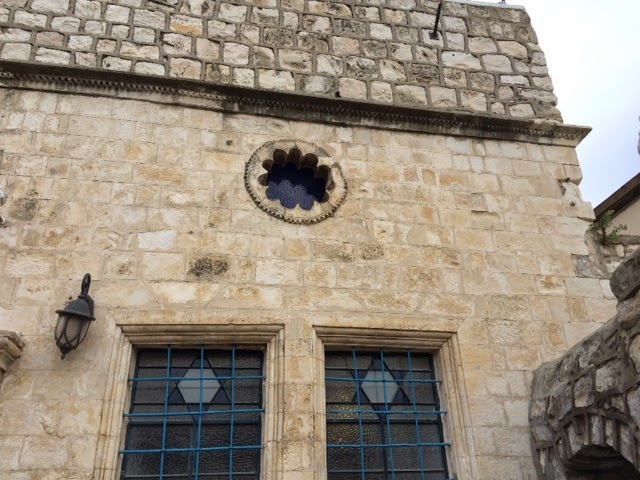


...and then proceeded down a beautiful alley full of amazing galleries and the best opportunities of the trip for significant and meaningful retail therapy.


Alas, we didn't have time for anything but high level browsing. Note to self: must return to this must not miss spot. (If readers are concerned I did not get in my usual shopping quotient, no fear as the Yad Vashem gift shop offered many fine opportunities to fill my extra bag-- and fill it I did.)

We ended the long day in Haifa at Maxim restaurant-- a Palestinian restaurant that was the site of a suicide bombing incident about 12 years ago. (The restaurant is "in the family" as one of our staff members is related to the owners ).  Of course, as elsewhere on the trip, the Palestinian food and hospitality were outstanding. More importantly, though, we were joined at dinner by 60 Hands of  Peace kids and their parents; it was electric and inspirational to hear their stories of hope and understanding.....
...while nearby was a reminder of today's reality:
We were fortunate to be seated alongside Judy and Amit (she is an American who made Aliyah  20+ years ago and now writes for Ha'aretz-- the left-leaning Israeli newspaper that many American Jews enjoy-- and he is a university professor who was on Rabin's team at the time of the assassination). Their son was in our San Diego Israeli Jewish delegation this past summer.  It was fascinating to hear their perspectives (they now live in Tel Aviv and love it there-- they used to live in Jerusalem but left because it was so intense-- this reminded me just a bit of the dichotomy we experienced between Shanghai and Beijing several years back). Most heart-wrenching though was to hear their story from this past summer. They have four children. Their oldest is in an elite infantry unit of the IDF so of course was on the ground for the Gaza operation this past summer.  They heard from him most evenings. Their next child, a daughter, is taking a gap year before entering the army. Their third child was in San Diego this summer attending our program during the Gaza operation. And their fourth child was at home. As Judy told the story of the family's angst, my heart burst for her. So difficult.


We checked into our hotel in Haifa to get some rest before our last day of touring. We started Thursday morning with a visit to the glorious Baha'i shrine and gardens. This was quite a fitting "last day" stop to our trip as the Baha'i faith speaks to all faiths and reinforces unity, diversity, and peace. While the narrative was interesting and somewhat compelling, several of us were surprised to hear how very conservative the doctrines are. That aside, the views were spectacular. 


Last stop-- a Druze village where we heard from a non-devout gentleman and a devout woman. (You may be aware that George Clooney's bride, Amal Alamuddin, has a Palestinian Druze background-- though she is not devout-- as intermarriage is definitely not permitted). Developed partly from Shia Islam, this ancient faith believes in reincarnation and very little reverence for the dead.
We were told that many Israeli Druze families support Israel (there are also communities in Syria and Lebanon).  Druze families go so far as to send their children to the army. Husam informed us (as it has been his role to do), however, that the Israeli Druze support for Israel is not unilateral.

In a journey punctuated by memorable dining (and when has that not been the case?), our lunch at the Druze village was an absolute standout. The platters kept coming and included (but were not limited to): hummus, home made flatbread with Zatar -- a zesty Mideast spice made from dried herbs including oregano and sumac, home-made flatbread with tomato sauce, roasted eggplant, rice, mini stuffed cabbage leaves, mini stuffed grape leaves, kebabs in Tahini, chicken, and amazing cookies .


All of this was accompanied by a tangy and sweet Tamarind tea.  We bid our good- byes and headed back to Tel Aviv for our late-night flight home.
  
As for our departure, security and check in at Tel Aviv's Ben Gurion's airport are really something else. We prepped our group that they should not volunteer that we had spent considerable amounts of time on the West Bank. It was " Kosher" for us to be there-- but a detailed description might be problematic for Israeli Security, so we were strongly advised to stick to a straightforward and simplistic script. As tour leader , I was singled out by security for fairly extensive questioning.  Good thing my mental and physical exhaustion did not affect my brain cells as I was able to answer the following questions with some semblance of agility: Why were you here?  Who was your leader? Did you have meetings? Why? What cities did you visit? Who was your guide (here, we had been explicitly coached not to identify Husam as a guide)? Why did you come early? Did any of your group separate from the rest? Why? Etc., etc. Then, I had to walk alongside our group with my new BFF Security guy to verify our group members (I was pretty pleased I did not have to recite names as by this point, I was wiped!), but that wasn't all. After my bags went through the initial screening, I was pulled aside so the friendly Security folks could do a deeper dive into my baggage for something suspect.  (Luckily, my laundry was elsewhere). Low and behold (gift spoiler alert!!!), they discovered that the Dead Sea salt gifts had set off some kind of alert on the X-ray machine. Fortunately, this discovery did not at all affect my ability to keep these gifts and continue through the security labyrinth. 

From the stirring moments at the Galilee and Capernaum to the mystical visit to Tzfat to the inspiring kids and parents and the Baha'i and Druze experiences, our last two days absolutely exposed us to yet additional narratives for this rich and emotional trip.  The last blog for this journey will contain our reflections. Stay tuned.

Peace, shalom, salaam,

wendy and emily

Broadening our Perspectives - Part II


Shabbat Shalom! We're back in the States and by the time you see this, we invariably will have slept in our own beds. But this trip was so rich, so intense, and so multi-faceted, we would not do it justice if we did not close out with some perspectives.

Let us start by reviewing that this was not an ordinary itinerary for Israel, Palestine, and/or the Holy Land. Conceptually, we did not visit one country, but two. Not only did we see places and hear speakers not usually included in such trips, we also engaged in dialogues most evenings-- facilitated by Rev. Dr. Chuck Mize from the Glenview Community Church (co-sponsor of the trip with Hands of Peace). Chuck did a masterful and extraordinarily respectful job of helping a diverse group process some pretty heavy stuff.  Indeed, some of what I've already shared in the blog is what I shared in our dialogue sessions.

So, with that, it's important you hear from both of us.

Emily first: "I honestly didn't know what to anticipate or expect as I prepared for this trip.  Knowing my mom had been planning the itinerary for over a year allowed me to trust her lead. However, I'm not sure I could have been fully prepared for what I experienced.  On our first day we were told it would be very complicated -- and it was.  We were given a privileged glimpse into the lives of Palestinians and Israelis, trying to make sense of the complicated realities of life in this historical land.  We were told that this is a land without history because history is being made in this place every day.  My heart was continually burdened by the lack of peace and the ongoing injustices -- made even more ironic by God's promises of peace and abundance that frame the story of the land.  Seeing the sights was a unique experience.  I walked away more encouraged in my Judaism; indeed, given the tumultuous history of the Jewish people, it is a miracle and evidence of God's promises that a widespread community of Jews still exist.  I also felt privileged to walk in some of Jesus' footsteps -- sure the dirt roads of that time have been paved over, but these were places where Jesus physically lived.  Overall, I came away with some tender seeds of hope, and those planted by the sweet, genuine relationships between Palestinians and Israelis -- not any grand political statements, but a commitment to love, honor, respect, and see the other person as equally human, equally deserving of justice, peace, and a place to belong.  I didn't have faith in politics before this trip and I certainly don't now.  But, I do have confidence that this story is not yet finished and the ending will be peace."  

Now, Wendy's thoughts: "Let me preface those by saying I am not anti-Semitic nor am I a self-hating Jew. I am proud to be Jewish-- by faith, tradition, history, and ethnicity. And nothing or no one can or will ever take that away from me.  Further, I am a 61 year old woman who just visited Israel for the first time-- with a strong interest in all things          multi-cultural, a social justice lens toward the world, and an openness to people with a different world or life view from mine.  Additionally, when I am not traveling in Israel, I serve on the North American Board of the Union for Reform Judaism (chairing a community initiative in the Chicago area), I serve as the current Chair for Hands of Peace, and I sing with Kol Zimrah-- the Jewish Community Singers of Chicago. I do not recite these roles because I'm applying for a job-- but, rather, because they inform the way I experienced this journey. (My myriad of other passions do not really play into my reflections here except, of course, my passion for a good meal and great shopping!)

More seriously, like the situation in Israel that we experienced, my relationship with Israel is complicated-- and quite emotional. As blogged earlier, my reaction at the Wall was affirming and life changing. My discomfort at Yad Vashem was expected. My fear in the refugee camp and in Hebron was genuine. My disdain and horror for how the Palestinians are being treated is real. When Husam told us his family had been in Palestine for over 800 years, that made it even more real. To synthesize those emotions, by the end of the trip, I tearfully expressed to my fellow travelers that I needed more. I wanted more exposure to the wonderful, vibrant, creative, warm, progressive Israel that I know is there but didn't have a chance to fully experience. I wanted and needed more balance.  At every Shabbat service, we sing beautiful songs for Shalom / peace. How can there possibly be such a disconnect?  I leave Israel having seen things I didn't want to see and having experienced emotions I didn't expect to experience-- but desperately clamoring for much, much more.

Despite needing more, I am proud to say that now that I've finally visited there, I love Israel-- more than I imagined possible. I loved sleeping in a room with a mezuzah outside the door. I loved hearing our ancient language used conversationally. I loved the zest for life. I loved seeing people who looked like me. I loved knowing this is my place.

Having seen the Hands of Peace kids from the Mideast so willing to take risks and lay it all on the line in engaging in a better future, I leave with a heart that is saddened, unfulfilled-- yet full of hope.  And I leave very ready to come back.

I also leave Israel feeling so blessed that I could travel with one of the most extraordinary women I know-- my daughter, Emily. We created memories that will be in my heart forever."

Thank you for accompanying both of us on this journey.
At Masada


Enjoying ice cream in Ramallah


Sailing the Sea of Gallilee

Overlooking the Mount of Olives


In the Druze Village


Emily with our tour guides (l-r)
Husam, Mustafa, and Yuval


Peace, shalom, salaam, and much love until we travel again,


wendy and emily

γειά σου (YAH-sas - Hello) - Greetings From Greece!

Some of our loyal blog followers may be confused by the title of this post. If you were expecting to see "The View from Vilnius", you are not going crazy. Yes, we had originally planned to take the Tauck "Russian Glories - Baltic Treasures" tour, but after Comrade Putin's excursion into Crimea, we decided to go elsewhere.

For those of you who haven't joined us before, welcome.  Through our blog, we hope you have all the fun of the trip--with none of the travel hassles, packing, physical ailments, or expense.  We're thrilled to have you on board.

So here we are in Athens, Greece.  We are doing this part of the trip ourselves (the itinerary map is below--Athens, Delphi, and Santorini) and then will catch the Tauck "Turkey, Land of Contrasts" tour starting in Istanbul.


Sunday, June 16 - Tuesday, June 18, 2014

A relatively short (for us) flight from Chicago to Frankfurt, a 2 hour layover, and then a 3 hour flight to Athens followed by a 30 minute ride to the King George Hotel got us in at about 2 pm. But it was about 6 am on our bodies! 

Our room overlooks Syntagma Square, which is where the National Parliament building is located. And looking in the other direction, we have a wonderful view of the Acropolis and the Parthenon! You'll have to trust us, because the photos don't do it justice (there will be photos later).

Meanwhile, Morpheus was calling to us, but we knew we could not succumb. Had to start to reset those clocks. So we got the standard neighborhood map from the concierge and headed out to do some preliminary sightseeing.  We walked up Ermou Street, which is lined with nice shops...yes, many international stores, but also many fine local ones. It reminded us of streets in Seville, Rome, Barcelona, Prague, Dublin.....but this does have a decidedly Mediterranean look and feel. We knew it was a long walk to and then up the Acropolis (and that was on our plan for tomorrow), so we just wandered through the maze of streets, catching tempting glimpses of the Acropolis every now and then. There were countless tavernas offering all of the Greek specialties.


Meze is similar to Spanish tapa: small plates with a mixed variety of foods.
And we saw many street-side stands selling the very popular sesame-bread rings called Koulouria.  


Athens, as a place where people have lived, dates back to 3,000 BC. According to myth, it was named for Athena who won a contest with Poseidon. Are there any other capital (or major) cities named for a Goddess?  Today, it is home to 5 million people.  Officially the unemployment rate is 21%, but our guide said it was higher. However, in the neighborhoods surrounding the downtown area we saw very few empty storefronts. We all know the same can't be said of our cities in the USA.

After about 90 minutes of walking in the heat, we headed back to the hotel to get ready for dinner. Adjoining our hotel (and owned by the same company) is the Grand  Bretagne (the old dame of Athens hotels), where we went for dinner at their Rooftop Garden-- known for its "best view in town" of the Acropolis. Actually, the Acropolis can be seen from nearly anywhere in town and it is amazing. Further, we just don't agree with those who poo poo Athens as a run-down urban sprawl-- not deserving of much time. We've been captivated so far and it would have been a mistake to miss it.

The meal was just as notable for the food as the view. Wendy started with cold ginger/garlic soup with a garnish of citrus cream.  My oh my. Then, she moved to the fresh grouper-- simply prepared with steamed vegetables. Delectable.
Wayne had roast chicken with gnocchi and vegetables...
...and finished with a dark chocolate cigar pastry served with dark chocolate sorbet; Wendy wrapped it up with a mouth watering almond cake served with berry sorbet. Any concerns we may have had about over-indulging (on the first day!) were going to be eliminated by our 8 hour walking tour on Tuesday.
We then hit the pillows and were out cold. Wayne did wake up at about 1:30 and just had to take a picture of the Acropolis lit up at night:
Actually, we juggled some things around and decided to split the tour over two days. We realized that eight hours was a bit ambitious even for us on day one.

The tour we had arranged was a combination Jewish tour of Athens and a classics tour capped off at the Acropolis. We started at the Jewish Museum of Greece  where we learned that the Jews have been a presence in Greece since the fall of the Second Temple (71 CE) - the Romaniot were the early Jews-- their descendants built Aytz Chayim (a synagogue we visited later in the tour, that was built in 1908 and recently renovated).

An influx of Sephardim (Mediterranean Jews) moved to Greece at the time of the Spanish Inquisition in 1492. Approximately 5,000 Jews remain in Greece today. Other significant Jewish communities throughout Greece (historically) included-- but are not limited to-- Corfu, Crete, and Salonika. The museum did a nice job of capturing the historical arc of the Jewish community here with many ritual items as well as a thorough treatment of the resistance effort during WWII. The Jewish tour also included a visit to Beth Shalom-- another synagogue-- this one built in the 1930s. We were surprised that the synagogue completely withstood the destruction inflicted on other Jewish communities during the war.  One sidebar: Both the synagogues we visited were traditional, meaning they are not part of the World Union for Progressive Jewry (a burgeoning sister movement  to the Reform Movement  in North America). Additionally, we learned that in traditional Sephardic worship, the women sit upstairs whereas in Romaniot worship, they sit on the other side of a latticed wall. The last component of the Jewish tour was a visit to the Holocaust monument--dedicated by Elie Wiesel. Set in a garden, the monument included seven different stone pieces shaped like a broken Star of David. This is to represent that Jews have been scattered, but still have a central place. Each piece has carvings of locations within Greece where Jews played an important role-- whether as a community or in a battle.


(You should be able to read either the Hebrew or the Greek: (Synagogue) Aytz Hayim - Tree of Life)


Beth Shalom

Holcaust Monument

The classic Grecian (and Roman) part of the walking  tour included: the Agora (marketplace)-- both Greek and Roman,


the Stoa (a column-lined shopping mall, much like that found in St. Mark's Square in Venice; note though that the columns are not original and reconstruction was funded by the Rockefellers),

the Temple of Hephaestus, blacksmith (and sword maker) of the Gods (and, actually, the best preserved temple in Athens), 
  
the Tower of the Winds, a unique 8-sided building that also functioned as a sun dial and water clock, 

and the Museum of Kerameikos (with some impressive 2,500 year old sarcophagi).


We also stepped into a store that sells 160 kinds of Greek wines and has them displayed quite impressively!

And, of course, lunch! We stopped for cool drinks (it was 35C-- equivalent to mid 80s and very sunny) at an outdoor cafe (in a string of same that went several blocks)-- overlooking the ruins of the Greek agora on one side with an ongoing excavation (partially staffed by American students) on the other -- with the Acropolis overhead. We had a thoroughly traditional and fresh (not what you would except from a tourist restaurant) lunch-- Greek salad, tzatiki, fried zucchini, chicken souvlaki, and meatball (which was actually like a very delicious grilled burger made with ingredients we would put in meat loaf!).

All of this was led by our superb guide Laura Giannola.

We then went back to the hotel and rested up...for dinner!

We walked to a place called
Το μυρμήγκι και το κρίκετ, or, in English, The Ant and the Cricket. It is a popular spot both with tourists and with locals. It features all kinds of authentic Greek dishes. When we sat down they brought us each a shot glass of ouzo and a bowl of mixed olives! (Those were free, but the bread was E1.50!). Someone really enjoyed her drink!!!

 We started with some fried Gruyere coated with sesame seeds and honey. Sounds strange, but sooo delicious. Also a plate of marinated fava beans with some hummus-like moosh. Tres bien! Then Wendy had moussaka (had to try it!). It was not at all like what it is in the States; more like a shepherd's pie.

Let's just say it was not her favorite dish of all time.
Wayne went with the simple grilled sea bass. It was very tasty....


...but the accompanying "greens" were quite gross.
The funny thing was we were eating the olives and the bread and our hands were getting greasy from the oil, but there were no napkins (or silverware). When the waiter came to take our order, he showed us that they were in a drawer in the table!!! Guess everyone is supposed to know you should take your own.

They had desserts, but we opted to go to a pastry store we had passed on the way to the restaurant. There we each bought one small piece of baklava (pistachio for Wendy, chocolate for Wayne). Again, this was not like the thick, heavy pieces we get at home. Each of these was no bigger than the top joint of your thumb, and just hundreds of ultra-thin layers of flavor and honey. Yes, to die for!

So ended our first full day in Greece.

Tomorrow (Wednesday): the Acropolis, the new Acropolis Museum, and a cooking class!!!!!

Love to all,  w and w..........


Antiquing and Eating

Wednesday, June 18, 2014

So we weren't exactly antiquing on Wednesday -- but we were immersed in the age of the antiquities with a visit to the Acropolis in all its splendor and the new Acropolis Museum-- followed by a visit to the food markets, lunch in the port of Piraeus, and a Greek "Sunday dinner" cooking class. (For those of you on FaceBook, you'll note we're posting photos instantaneously but lagging at least a day behind with the blog. Can't write as fast as we can post!)

Our first stop was the Acropolis and all the many temples (most restored but some original) located on that magnificent hill. The Acropolis is the crown jewel of Athens and a worthy crown indeed. First inhabited in the Neolithic Age, it was then inhabited by the king in the Mycenaean period. It is best known, however, as a place of worship to the gods-- as early as the eighth century BC. Let us step back for a moment. With so many ruins everywhere you go in Athens, we suppose it  might be easy to get nonchalant about the import of what's here. Being in historical places always thrills us, but Athens and the Acropolis in particular, took history to a new level. We were blown away by Angor Wat, for instance, but that was constructed in the 1100s.  The Taj Mahal was finished in 1648. So to know that we were standing on hallowed ground where the Greeks came to worship their gods over 2,500 years ago is nearly unfathomable. But we saw the ruins and artifacts to prove it.


The plan to build the Parthenon (temple dedicated to Athena) and the gateway (the Propylaia) was put in place beginning in 450 BC.  The enormity of the site was overwhelming--particularly fascinating was that we actually saw some original sections of  the Parthenon and other temples. Restoration is always going on at the Parthenon as 2,500 is a legitimate age for wear and tear.
The oldest known theater in the world
There are at least eight monuments (most of them temples) on this sacred rock and each is extensively adorned with incredible statues, friezes, and more.  You probably need three semesters of Ancient History to begin to process this. 


Our next stop was the new, award winning Acropolis Museum. Opened in 2009, the museum overlooks the Acropolis and organically reflects the flow and shape of the landmark while incorporating an actual archaeological site (of a Christian settlement) in the basement level (much as the Chinese built a structure over the terra cotta warriors, they did the same here, only it is a multi-story museum!). So, as you are walking across the floor of the museum, you are actually walking "over" the site. A little bit unnerving. The collection is awe-inspiring-- including a wide array of artifacts (all found on the grounds of the Acropolis), along with a re-creation of the friezes and metopes that adorned the Parthenon. 


We realized mid way through our tour that Wayne had engaged in a serious wardrobe malfunction in selecting his Rosetta Stone British Museum T-shirt for this particular day. The Acropolis and the antiquities there have been pillaged over the centuries. For those not in the know, a particularly discouraging incident was when Lord Elgin ordered the detachment of the greater part of the Parthenon's frieze and shipped it back to the British Museum (where we saw them last year; hence, the inappropriateness of Wayne's wardrobing choice). There is somewhat of a philosophical difference of opinion among art historians (and tour guides) in terms of the actual harm done by Lord Elgin (et al). Apparently, while the rest of the world was very enamored  by Greece's treasures, the Greeks were not. So perhaps these "acquisitions" were a blessing in disguise since these unique pieces were actually saved from further damage or destruction.

Ok-- what do most folks do after an intense morning of ancient history, friezes, and Grecian statuary? Think about food of course! To get to our next place of interest, we took the Athens metro (we always try to do this on our trips, and the more complicated the better). Like so many other institutions in Athens, the metro was "freshened up" prior to the 2014 Olympics This line was distinguished from others we've traveled on because of the huge archaeological wall display (revealed in the restoration)-- an integral part of the ambience-- so Athens!  As in other cities, they apparently believe in the honor system. You buy a ticket (the standard is 90 minutes unlimited use for 1.40 Euros), and then put it into a machine to timestamp it. But there are no gates or turnstiles!  You just walk through. And you don't need it to exit when you get off. There were lots of signs saying the penalty for fraudulent use or not having a ticket was 60 times the ticket price (yikes!), but we didn't see anyone checking.  Anyway, we took the metro for 3 stops to the Omonia Station to get to the Dimotiki Agora (Central Athens Public Market).  Markets are also a Wendy/ Wayne travel mainstay. This one did not disappoint (though the lamb heads were particularly terrifying). 
Other highlights were fish of all types (we understand that octopus is a real delicacy in Greek cuisine and one of us intends to try it in Santorini upon my cousin Alan Hirsh's recommendation-- Wendy is hoping not to repeat the Cusco guinea pig experience)...
...gorgeous produce...
...spices, and olives ( apparently there are 60 + types).
Great market.

By this point we were getting hungry so we hopped a cab (yet another harrowing ride!) for a restaurant in the port area of Piraeus (recommended by our guide Laura) and a light lunch,  the highlight of which was definitely the tiny fried shrimp.


We walked around a little and then cabbed back to our hotel to rest up for the night's featured event: the cooking class scheduled from 5:30 - 9:30. What a blast!!!! It took place at Klimataria Greek Tavern in the Omonia section of Athens (www. klimataria.gr/). This is said to be the oldest tavern in town! We stumbled upon this class and were so glad (and stuffed) we did. Taught by the proprietress, Maria, it was a combination of demo, prep, and force-feeding and well worth the calories. We were joined by a newly-wed couple who had extraordinary slicing skills. (Both are nurses; we hoped that their bandaging skills would not be required). While the menu was billed as 6 starters and 1 main course, we actually had 10 starters and 2 main courses and with her larger-than-life (think "My Big Fat Greek Wedding") persona guiding us along, Maria was genuinely distressed when we didn't clear our plate at every turn. What is the Greek equivalent of OY?

When we sat down, we were served slices of a delectable tomato/ spinach bread along with ouzo and/or beer (Appetizer 1). Next Maria (with our help kneading the dough and prepping the eggplant and feta cheese mixtures, then shaping) prepared mini eggplant pies (mpourekakia),  mini cheese pies, and a regular size eggplant and cheese combined pie(appetizers 2, 3 and 4).


Then, we moved to some major league slicing and chopping vegetables for a Greek salad (horiatiki - note:  there is NO LETTUCE in a Greek salad!) and saganaki (which, apparently in the 21st century is not just prepared with cheese alone-- take the salad ingredients, place in a casserole dish, add more cheese and 3 beaten eggs-- cook at 400 for 20 minutes and it is basically a Greek frittata (appetizers 5 and 6). 
Let me just say that the tomatoes we have been served are exquisite. What a shame that we only get great tomatoes in Chicago for 6 weeks every summer. Next we prepared three dips: eggplant (melitzanosalata), red pepper/feta dip, cucumber dip (tzatziki)--(appetizers 7, 8 and 9), then grape leaves stuffed with seasoned rice (dolmadia -  appetizer 10).
While we were preparing and being force fed, the cook was putting the finishing touches on a feta spinach bread for our enjoyment.
As an aside, many of these dishes included a plethora of fresh herbs, all were salted liberally, all included generous amounts of extra virgin olive oil (which, per Maria, is "medicine"), and Maria did not back off on the garlic. Each item was tastier than the prior one and Maria kept asking us to repeat the ingredients or prep techniques. Wayne was particularly talented in the repeat department.

We were starting to feel fairly uncomfortable (yes, the wine was flowing by this point), when Maria asked us to move to the beautifully set table toward the kitchen because a roasted lamb shank with potatoes (the MAIN COURSE!) had been cooking in our honor for the past two hours. She explained that, with Greece's uneven terrain, the animals farmed for meat are quite lean due to their habitat and they eat the natural vegetation so they are more " tasteful" (alas, she meant tasty). She taught us an interesting trick about roasting lamb (or any meat)--cut several slits in the meat and plug in some heavily salted/ peppered garlic cloves. This preparation will prevent the gamey cooking smell associated with the meat.
With not a minute to spare in this Greek eating feast, we sat down at the actual dinner table where a plate of braised beef on a smoked eggplant purée (not exactly my grandma's brisket)...
...and then the lamb were waiting. The 1/8 of a teaspoon we had room for was yummy and so were the potatoes. Maria was thrilled we liked the meal and the class, and we waddled out the door-- convinced we would never eat again. Interestingly, because the lion's share of the meal was vegetables and olive oil (think Mediterranean diet) our discomfort was not prolonged. What a fun experience-- ranking right up there with our Bangkok, Beijing, and Delhi cooking classes. 

Two other notes: Though the restaurant was open the whole 4 hours we were there, there were only two sets of people who came in to eat. Obviously they were American tourists, because, as Maria explained, the locals don't come in until 9:30 or 10.  Also, here, as in all public places, "No Smoking" signs were prominently displayed (by law). But apparently this is ignored by most people without any repercussion (we did see people smoking in the restaurant the previous night). 

Having had a very full day, we crashed in preparation for our visit to Delphi on Thursday.

By the way, we're thrilled so many of you are reading the blog. As always, all comments welcome.

Love,

w&w