Where in the world are Wendy and Wayne??? We love to travel and explore other cultures and foods and the beauty of the Earth. And we love to share all these adventures with you!! When you travel with us, no cost, no shots, no hassles, and no risk of Montezuma's revenge! The slideshow below shows some of the places we've visited. The individual posts have all the details.
June 15, 2011
Nihao,
Thursday, we finally disembarked from the Yangzi Explorer. We did boat-to-funicular-to-bus-to-plane-to-bus-to-boat-to-bus--starting in the city of Chongqing (pronounced "chun-ching" which used to be known as "Chungking". Remember those cans of Chinese food?). The city is located where the Yangzi and two tributaries meet, so the city is divided into three parts. This is another large (7 million+) city which is experiencing major growth (see below). There are blocks of huge apartment buildings, many multi-level expressways, and a monorail to various parts of the city. We were treated to a spontaneous panda visit. As it was early in the morning, we actually saw them moving around (much closer than at the San Diego Zoo!).
The people at the zoo were just as fascinating--groups dancing to music (men and women couples and same sex couples), tai chi, or playing cards. Our guide explained that all of these in some way encourage socializing, a big part of Chinese culture (he also attributed the loud talking to this need to socialize).
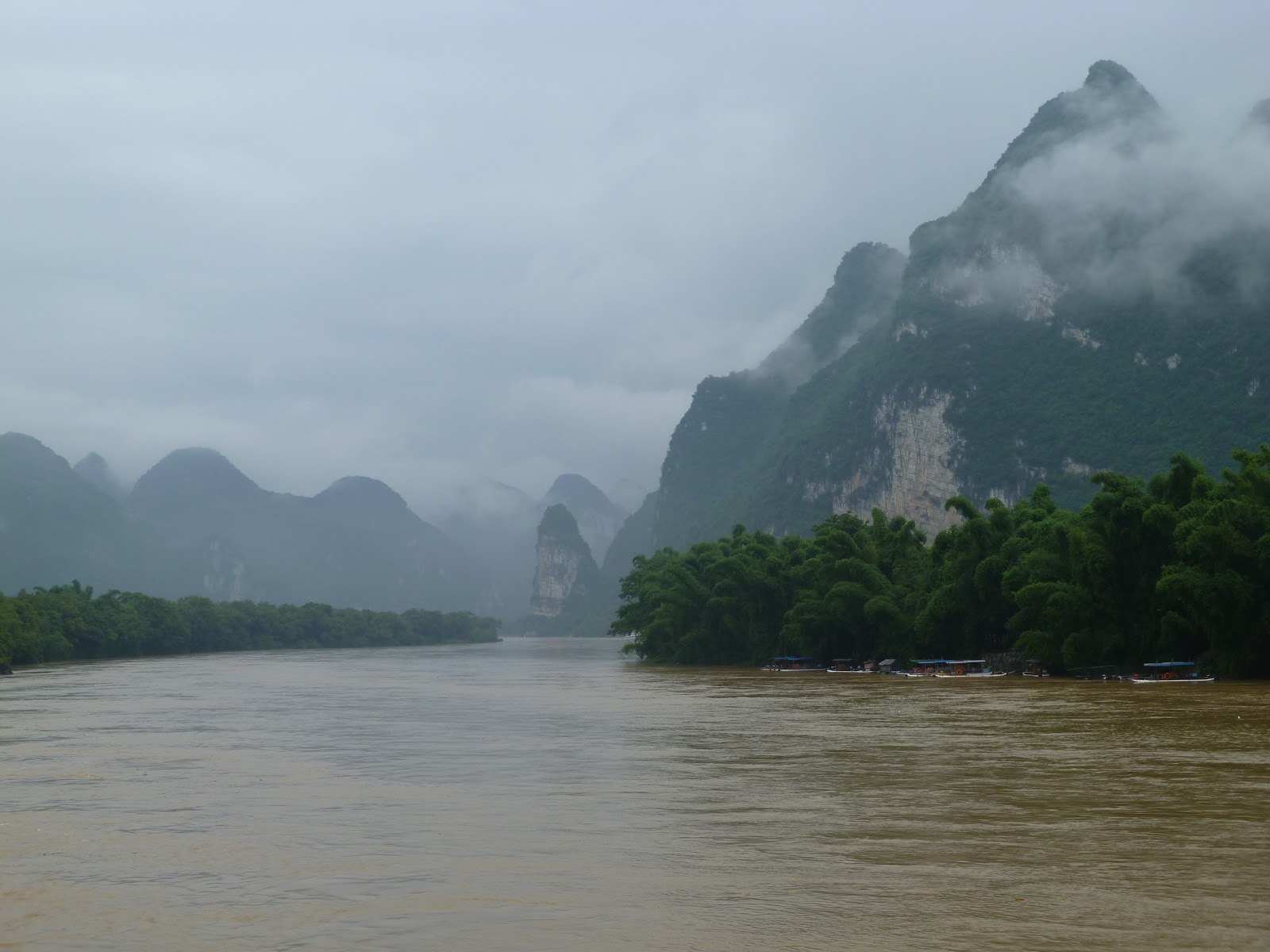
Then on to Guilin. This area is known for its karst geography. It is filled with many miles of large limestone mountains. Of particular note are those located along the Li River. Use your imagination here--when you see Chinese watercolors of mountains partially hidden magically in the mist, that's where we were and precisely what we saw. The beauty was absolutely spiritual. Of course, like most cultures, the Chinese have given almost every mountain a name based on some perceived shape or "picture" on its face. There is the Phoenix mountain and the Dragon mountain (what a coincidence!). Soon we were all trying to imagine things that wee saw on the mountains; two monkeys looking over a cliff, a witch's face, etc. It was really a magical mystery tour.
After about an hour it was time to get off, but, since the river was already approaching flood stage, the normal dock was unusable. So we had to find a clear (but muddy) spot on the bank and kind of run aground there and walk over the water on the gang plank. Then up the embankment and we were in a tiny town (yes! Less than 1 million people!!! Probably about 100). We saw how a small village really looks.
An unrelated aside. Our guide told us today that 92-5% of Chinese are of Han ethnic roots, there are 55 other ethnicities (you will recall that the one child rule does not apply to families among these minority ethnicities). The many decoratively dressed dolls in the gift shops represent these different ethnicities. The area surrounding Guilin is populated by many ethnic Chinese.
Friday morning we were off to the airport for Xian. There is a beautiful new 8 lane highway that travels the last 10 km to the airport. Our guide explained that this is how they make a good first impression when dignitaries come here. It shows how prosperous and productive and happy the people are. It was somewhat pride and somewhat party line). We arrived in Xi'an at about . This is another city (of 7 million give or take 100,000) that has seen explosive growth in the last 30 years, much of it due to the discovery of the Terra Cotta Warriors --to be described in our next update.
After landing we were taken to the (Buddhist) Wild Goose Pagoda, which was built 1,300 years ago! In front of this is a compound which was built "only" 300 years ago. This used to be the heart of the old city which was surrounded by a wall (now it is surrounded by a Papa John's, a Dairy Queen, a Starbuck's, and other examples of a booming "socialist market economy"). In the compound are several large temples with golden Buddhas inside. There are also two smaller buildings: the BellBuilding and the DrumBuilding. In the old days, the bell would sound at and the gates to the city would be opened to let people go to the fields, etc. At the drums would sound and the gates were closed for the night. If you were late, too bad. Sounds just like bus departure time on the tour! While the majority of Chinese don't practice any religion at all (a hold-over from Mao's reign) the primary religions that are practiced in China are Buddhism and Daosim (same as Taoism).
Note, as we were heading down to the business center prior to dinner, we ran into a group of well-dressed Chinese gentlemen coming out of an adjoining conference room. One of them we recognized as Chinese President Hu!!!!! We asked the business center personnel "Who were those people" and she replied "Our government"! Earlier this week (was it just this week!) our Shanghai guide had given us a Chinese government primer that sounded like it was straight out of an Abbott and Costello routine. She asked us: "do you know who is the Chinese president?" and we all said: "no, who?" And she said: "Hu! that's right" and we said "who?" You get it. The gentleman who is the second in command is Wen (though our own wen-wen thought it was HOW). Perhaps you have to be here to appreciate this joke (or be drinking copious amounts of Chinese beer)...but we thought this was very funny.
Now, a dinner synopsis. We had a choice of restaurants in the hotel this evening (all of which are excellent (and one of which was Chinese). Ironically, we were the only ones in our group to choose the Chinese restaurant as most members of our group claim they will never eat Chinese food again (and we have another week of touring and eating left!). Anyone, we dined at Tian Jiang Ge which is an upscale elegant restaurant in the Shangri-La Xian. Based on our guides' talks, the Chinese use every possible part of every possible animal and this was apparent on our menu (though not with our choices). So, for the record, we did NOT order: durian puff pastry, sliced pig stomach with leek and vinegar, roast pigeon with head and beak, abalone and sea cucumber combination plates (over two pages in the menu dedicated to these dishes alone), stir-fried pork knuckle with peanuts, tossed jellyfish with garlic, chicken feet marinated with rock salt, sliced fish skin with vinegar sauce, mashed garlic with pig ear terrine, or braised goose feet with abalone sauce. Our selections were rather conservative, but still very delicious. We started with wild mushrooms with minced garlic. This dish was not described as being hot but we almost needed to call in the fire department for way-way. Next, we feasted on stir-fried French green beans with minced pork, sauteed prawns and scallops with black bean sauce, and fried vermicelli Singapore style with barbeque pork. Our dessert was ice cream (OK, we caved but we needed something to cool the heat) and baked cream honeycomb puff--which looked like three huge hairy tater tots with a warm sweet crunchy filling.) In our defense, while our choices were conservative, the presentation and flavors were very different from what we would have had in the States.
More observations and learnings since our last posting. Per the latest census, the population is now almost evenly split between urban and rural. Almost all farms are managed (the government owns the land) by individual farmer families. Their plots are about 1 or 2 acres. Nearly all of the farm work is done by hand. Many young people are leaving the farms for the city. They estimate that about 40 million people are on the move. This is reflected in the tremendous amount of building going on across the country. At one point a few years ago, 50% of all the heavy cranes in the world were in Shanghai (not just in China, but in that one city!). Couples may move from the countryside to a city and leave their (one) child with the grandparents. They work to make money and may be gone for several YEARS at a time! We described the toilets at the Waldorf. Well, outside of the hotels, everywhere else has "eastern" toilets (i,e,, a hole in the floor). This did not seem to be the case elsewhere in Asia (at least not where we stopped--India, Thailand, Cambodia, Viet Nam, Japan), but the Eastern toilets are unavoidable in China in public places. However, they always have one "handicap" stall which has a "western" toilet--usually out of order. By the way, very few of these stalls (east or west) have toilet paper! In the men's room at one airport for example there was one toilet paper dispenser on the wall as you entered. Apparently you're supposed to guess how much you'll need and tear off that amount BEFORE entering the stall! Luckily, we learned many years ago to always carry a roll with us, so we are prepared. And, needless to say, wen-wen's extensive workouts throughout the years (resulting in very powerful quads) have come in quite handy! Another observation...there are collection boxes in the hotels and museums for donations to help the earthquake and tsunami victims in Japan. We found this to be very strange after continuously hearing of all of the times Japan has aggressively attacked China. But our guide explained that many Japanese companies are getting many supplies from China to fill their gaps, so it seems like both sides are benefiting.
June 20, 2011
Nihao,
Saturday, we had an early departure to see the famed Terra Cotta Warriors. We left early because our group is allowed special access before the museum opens to the general public.
The warriors were first discovered in 1974 by farmers digging a well. Since then, the archaeological work has been, and is still, going on. When you walk into the first and biggest building (over 16,000 sq. meters), the scene is overwhelming. All together they estimate there are over 8,000 figures. In Pit 1, over 800 have been restored. This picture gives you some idea.
This pit contains 11 rows of warriors; mostly infantry here, but there are some archers and horsemen with their horses. The place where the farmers happened to dig is in the front left corner of the first column. If they had dug 5 ft away in either direction this wonder might never have been discovered. It is below ground level for several reasons. One is that the emperor had it covered with wooden planks (the "walls" in between the columns of figures were used to hold the roofing timbers). So it actually was about 7 feet below ground level when it was constructed. Second, this area is near the Gobi desert (this is still a very dry region), so over the centuries blowing sand has raised the ground level about 10 feet. Indeed, during this long period, the timbers eventually were burned and there was periodic flooding. So nearly all of the figures were found in many pieces and had to be completely reconstructed.
The figures each stand on a base, so they are over 6 feet tall. There is some debate as to why this is so (since the real soldiers probably were not this big). Also, the horse statues look like ponies. The archaeologists have determined that this was the actual size of the horses in China at that time! One way they did this is because there are no stirrups (and everything else is realistic down to the minutest detail. (For example, the soles of the kneeling archers' shoes.). So this shows that the soldiers' feet almost reached the ground when they were riding. It was not until later that larger horses were brought in from Mongolia, and Arabians, and cross-bred that the horses were the size we are used to seeing today.
This huge army was the work of the first Qin ("Chin") Dynasty emperor in about 210 BC. He was the person who actually unified the country from a group of (often warring) states. The custom for the local "emperors" (war lords) prior to this one was to bury his army alive when he died so that they would be with him in the next life. But this emperor had lost so many men in battle that he wanted to reward (and spare) his remaining soldiers, so instead he ordered the creation of these clay figures. Originally, they were painted in the bright colors of their uniforms, but due to the fires, floods, and time, the colors are all but gone now.
Almost as impressive as the warriors themselves is the fact that they built these huge arched buildings right over the pits without bringing in any heavy equipment! This site is now second behind the Great Wall for most visited in China, and is the largest on-site museum in the world.
Next we were treated to a mega (13) course dumpling lunch!
Each table of 8 seats had a huge lazy susan in the center. When we went in there were plates of pickled baby cabbage (hot!), but luckily the beer was included and they kept our glasses full. Other first course appetizers were plates of crunchy sweet and sour meatballs (better than IKEA!), and a platter of sliced veal and mushrooms. Then the parade of steamed dumpling plates began. (As a side note, many of the dumplings were twisted into interesting shapes--corresponding to their contents. For instance, the chicken dumplings actually looked like chicks). Here is the order of the dumpling parade. We started with spicy chicken, moved on to lotus root with and pork (which some mistook as "locust" and pork), shaomai (dumpling filled with fried rice), yuan pao (more pork), sesame duck, pork with corn and fungus (mushroom), then a dumpling that had been colored with cocoa and filled with sweet walnut meats. Next, a fried dumpling arrived with lotus root and tofu followed by a chicken broth with several varieties of boiled dumplings (each the size of your fingernail). According to the guide, the number of dumplings that landed in your bowl directly correspond to your likelihood of good luck, prosperity or longevity. If you receive no dumplings at all, that is the best message. We each received three dumplings--a sign of a good future (and more travel?). The last course was a platter of fresh seasonal fruit (they are very big on watermelon). This meal was really wonderful except that many of us (one of your writers included) have begun to refer to themselves as "dumplings".... given our consumption over the past two weeks.
- - - - - - -
More learnings and observations: Until about 15 years ago, only the very few elite could afford a car. So public transportation was (and still is) a major way for most people to get around. But increased prosperity has allowed more and more people to own and drive a car. So there are MILLIONS of inexperienced drivers in China! It is not as chaotic as in India, but there is still much disregard for traffic lights, lanes, right of way, etc. Speaking of which: we have been in many countries where pedestrians do not have the right of way. But we have always been told to walk confidently across the street, don't stop once you start, and don't look at the drivers; they will drive around you. And we have been successful (though mighty scared) following this advice. In China, this policy does not work! They will drive right over you!!! So we have seen many Chinese cross the street one lane at a time. Walk, wait, walk, wait, run for your life! Here in Xi'an there are many beautifully decorated (with flowers) pedestrian overpasses at some of the bigger (more dangerous) intersections.
Re the one-child policy: There have been some negative (and perhaps unexpected) results. First, males are more highly prized than females as they can earn more (in general) and have a higher chance for success. So many women chose to have an abortion when they found they were carrying a female, and to try again. As a result, there are now 20 million more males of marrying age than females! Also, tradition says that the children take care of their parents in their old age. But since each family (parents of the husband and wife) had only one child, these children must take care of BOTH sets of parents. And the parents are living longer. This has put a huge strain on many people's expenses and lifestyle. Also, if you have a government job and have a second child you are fired immediately. But for non-government people, you can have multiple children if you pay a fine: 20,000 Yuan for the 2nd (about $3,000), 30,000 Yuan for the third, and so on.
It is now Wednesday afternoon on the 22nd. Our tour is officially over (except for the farewell dinner tonight). However, we are staying until Sunday, and we have many other special activities and eating events planned, so we will have lots more to report!
We flew from Xi'an to Beijing on Sunday and were immediately driven to the central square of the 2008 Olympics This is where the National Sports Arena (better known as "the Bird's Nest") is located. This was the site of the opening and closing ceremonies, as well as track and field events. This open-air stadium seats 90,000+. Surrounding it are a wide pedestrian walkway and several other Olympic buildings. Over 300,000 people were "relocated" to make room for these venues.
Beijing (population 19 million) is the government center of the country (Shaghai is the financial center, Xi'an is the historical center). The Forbidden City (more below) stands in the center. The streets around the Forbidden City are considered the first ring road. As the city has grown, the government has added more and more rings. Our guide, who is in her thirties, said that when she was little, she lived on the outer edge of the third ring road, and she could see rice fields out her window. Since then, a fourth ring road has been added and they are now beginning work on the fifth! Within the third ring road, it still looks like old Beijing, Other than in the Central Business District on the east side, there are not many buildings over 20 stories, and still the majority are much smaller. There is not the same ubiquitous frenzied building atmosphere nor number of condos that we saw in the other cities. And the smog! Our guide was not at all reluctant to say the words "smog" and "pollution", though she was quick to point out that it is much better than it used to be. If this is "better," we honestly don't want to know what "worse" was. We didn't have any problems breathing, yet have never seen the likes of this.
After seeing the Olympic area and a short tour of the city, we were taken to our hotel. It is a nice place, but not exceptional other than the Rolls-Royce dealership at one end of the lobby and the Bentley dealership at the other end.
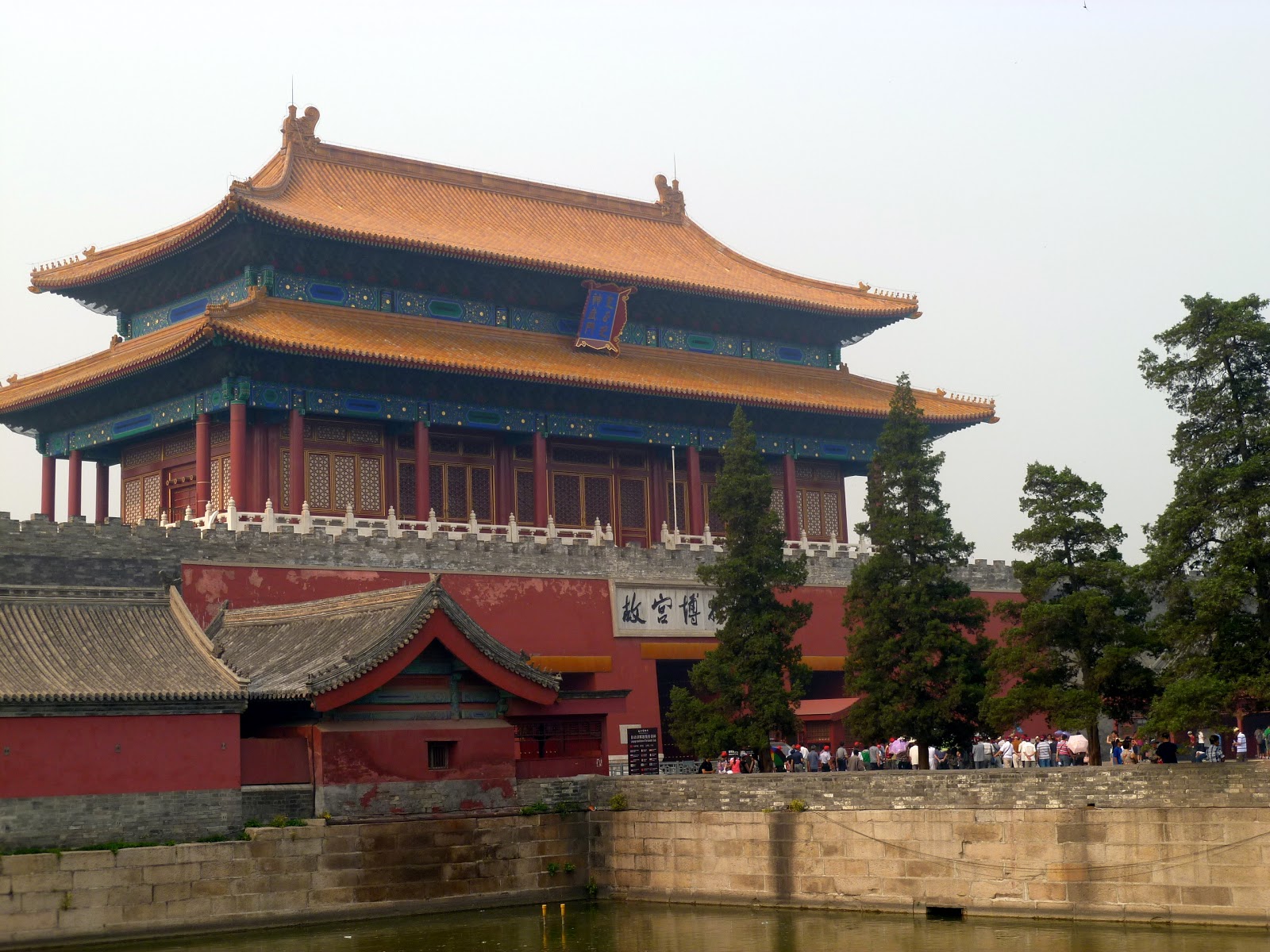
Monday we had an early start for a day of walking (and the temp was in the low 90's) where (with our nearest and dearest 1,000+ newest friends), we visited the Forbidden City, then Tiananmen Square. First we the Forbidden City (officially known here as the "PalaceMuseum").
This complex of 9,999 1/2 rooms and gardens was (mostly) finished in 1420 by an emperor of the Ming Dynasty. From that point on over 28 emperors (and their empresses, concubines, attendants, and immediate family members) resided here. It is much like imposing royal palaces we have seen in Tokyo and Delhi, but of course with the traditional Chinese curved roofs and many dragon-adorned lintels and eaves. There were many staircases and ramps which were reserved solely for use by the emperors; anyone else using them would be beheaded (ouch!). Of course, now we were able to use them with impunity.
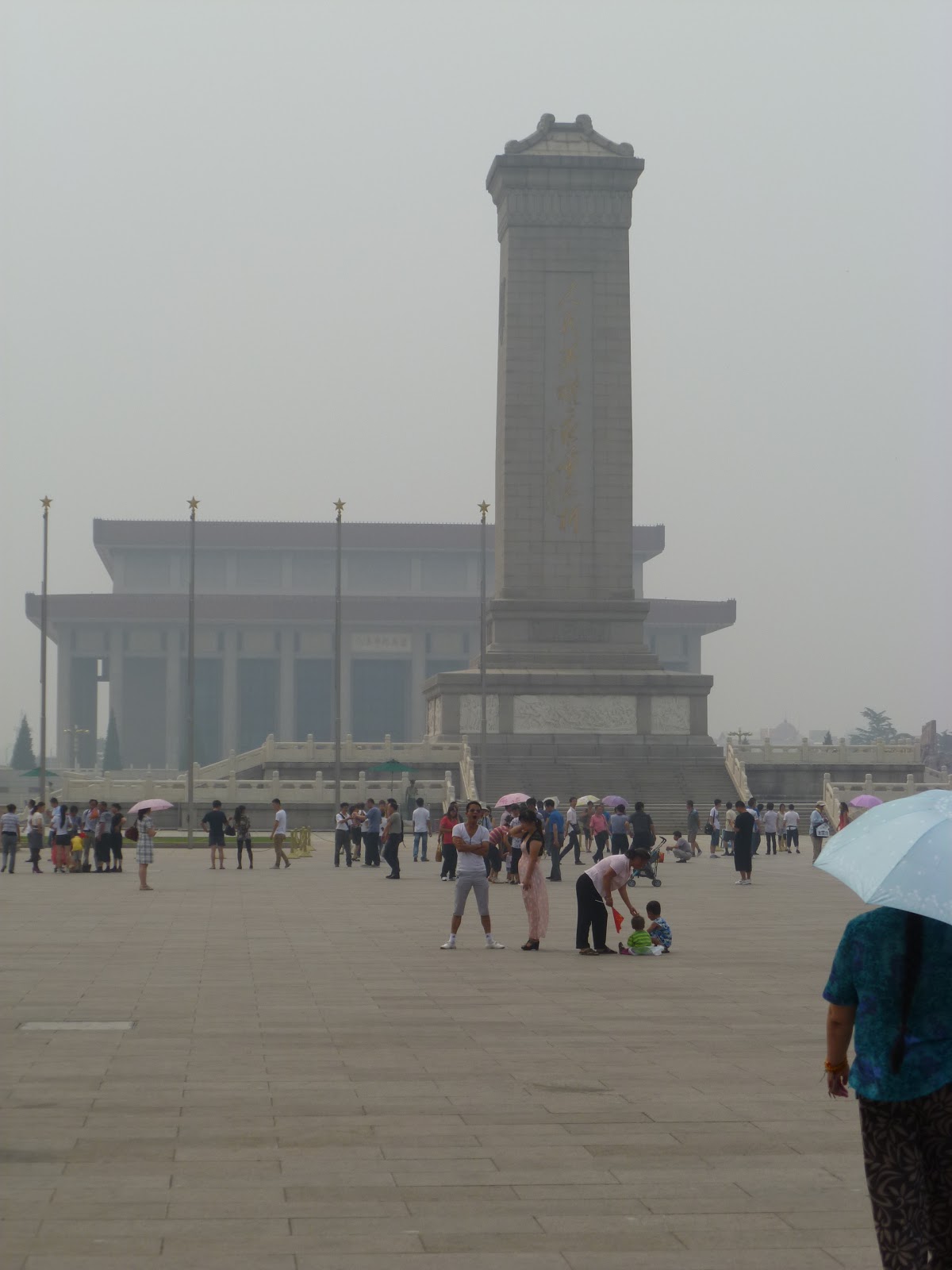
Next, we left the Palace through the south gate, crossed a small street and went through Tiananmen Gate (which means "gate of heavenly peace"). This used to be the main gate of the city. Shortly after Mao took power in 1949, he visited Red Square in Moscow. Since the Russians were close friends of the Chinese, and he wanted his country to emulate the Russian communist/socialist model, he decided Beijing also needed a similar square. So he ordered that Tiananmen Square be built at this spot. It is the largest square in the world (what a surprise!), and can hold 500,000 people (in other words, a small Chinese suburb). It is surrounded by government buildings (one of which is now the NationalMuseum). At one end Mao's picture overlooks the square.
At the other end is his Mao-soleum. It was absolutely awe-inspiring.
In the afternoon, we were driven to one of the many hutongs. These are small neighborhoods of one story homes, many of which are over 100 years old. "Hutong" is a Mongolian word meaning "water well". As Mongolians and other people settled here, on the southern edge of the GobiDesert, the first thing they did was look for water. Since the hutong roads were created in the pre-auto age, we were taken in via bicycle rickshaws (i.e., the "tuk-tuks" we've been on elsewhere).
It was fun, but not as chaotic or harrowing as on some of our other trips. We went to the home of a man who is a calligraphy and painting teacher. He also showed us the 60+ racing pigeons that he raises. Though his home was built in the 1880's (and has been in his wife's family ever since), it has been modernized (indeed, at 2,300 sq-ft., it is bigger than our house!). As we sipped tea in his kitchen he told us about how the home was acquired and life in the hutongs. On the kitchen wall was a picture of his mother-in-law in front of the White House and his wife and our host in Las Vegas! So we guess they are doing all right.
Then back to our hotel to get ready for dinner. While there (remember it was about on Monday) we turned on ESPN and saw a tape delay of Sunday Night Baseball: Cubs vs Yankees at Wrigley.....announced completely in Chinese!!!!!!! Language notwithstanding, the Cubs still lost (actually, we had tickets to go to that game but had to sell them since we were on the trip! As a side bar, we had asked several of our dear friends and family members to "look after" our beloved Cubbies in our absence. Sad to say, they have failed miserably and, in keeping with our new respect for Chinese tradition, those individuals will lovingly be beheaded upon our return!). We went for a walk before dinner to a local attraction...the outdoor food market. (In hindsight, it was good to go before we ate).
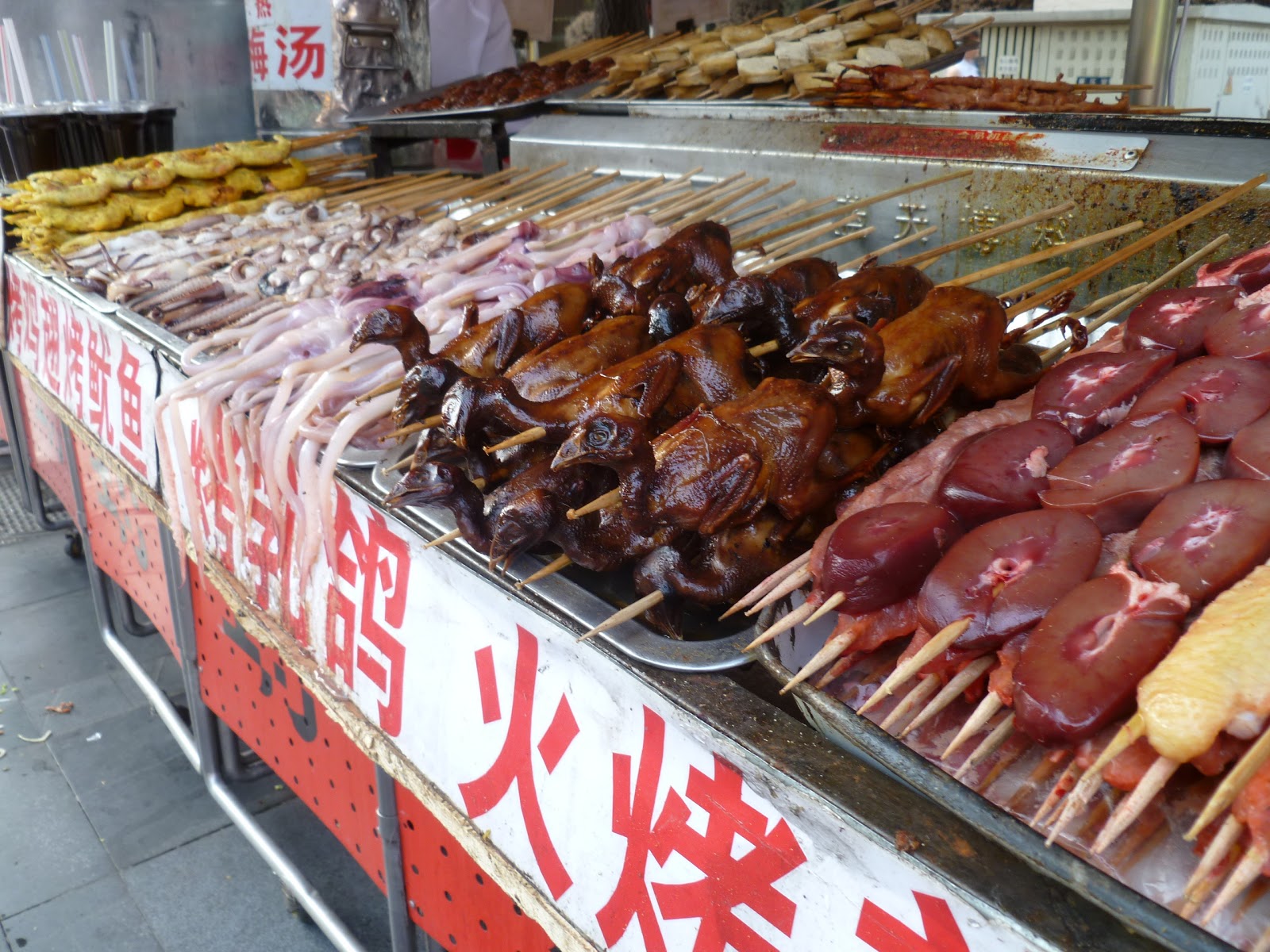
We know our readers have been itching for another food description. Here it comes. This block-long set of stalls features fried foods of an exotic nature. Now it seems to us ok to eat creatures such as shrimp, crabs, external chicken parts (e.g., legs and wings), and lobsters, but this market featured skewers of: snakes, squids, silk worm larva, scorpions, sea mushrooms, starfish (seem to be a lot of weird "s" foods!), bees, crickets, grasshoppers, lamb hearts, whole pigeon (yes, head still attached), and lots of fried sweet treats like durian puffs, fried ice cream, and various fruits with a candy-apple-like coating. You can imagine the smell. No, wait....you cannot!!!! (Speaking from the experience of encountering lions eating a several days-old rhinoceros carcass in Krueger Park, South Africa, this smell was a close second and extraordinarily distinctive.) After all that (and the heat), we had to get some refreshment, so we went across the street to a huge 6-story mall and found the Dairy Queen! The flavor of the month was Mango Blizzard with Swiss cheese chunks. Yes...you read that correctly.
So, we opted for a mango-passion fruit smoothie. So good! Also in the food court was a restaurant touting their "squid lips and pork knuckles" special! Then we joined friends for a delicious dinner at the Peninsula Hotel. Afterwards, while walking back to our hotel we had more sorbet at the Hagen Dasz store (HD is very big in China).
Tuesday we had another early start for one of the high points of the trip: The Great Wall. It is about 60 km from the city, so it was a 1 1/2 hour bus ride (the traffic is incredible!). As you get closer you begin to see the Wall snaking across the mountain ridges (built on the ridges for obvious defensive purposes). The wall was originally built as individual walls constructed by the various war lords and chiefs over the years (beginning about 5,000 years ago). But under the Ming emperors (1600s) it was finally completed as one 4,000 mile long structure. Indeed, the Chinese call it "The Long Wall". Of course, it is the longest wall in the world! We began our ascent at the Badaling section (there are many different places where tourists can climb). OK. In past editions for past trips of our blog, we've indicated that we were running out of adjectives. Well, just let us say there is a reason why The Great Wall is one of the Wonders of the World. It is just stupefying and breath-taking to imagine something this massive (20 feet high, 4,000 miles long) all made out of stones. To see it from the bus then actually climb it with another horde of tourists almost defies description.
We walked about 1 1/2 miles to the farthest point allowed. The walkway was at times stairs (of various random heights, some in not-so-good shape) and steep slopes (many over 60 degrees). And it was very crowded and people continually stop to take pictures. The total incline was several hundred feet. Luckily, it was cooler there and there was a nice breeze, but it was still a relatively difficult climb (certainly a lot more difficult than our daily walk of 1-1/2 miles to downtown Deerfield).
And the descent was no piece of cake either! At one point we came upon a class of blue-uniformed 3rd graders on a field trip (to the Great Wall!!!!) and they all crowded around us for a picture. It is very funny: when we see the kids we shout "Nihau, nihau!" and they shout back "Hello! HI!"!!! Needless to say, we succumbed to two "I have climbed the Great Wall" t-shirts--wouldn't you?
Then we were taken to a beautiful secluded resort and treated to another multi-course Chinese lunch. This one featured: assorted marinated cold dishes (including that disgusting fungus again), assorted dim suns (including a cookie shaped like a carrot), stir-fried duck slices with Chinese broccoli, diced beef soup with bean curd, egg white and mushroom (another gelatinous dish for which we took a pass), stir fried pork with pineapple in sweet and sour sauce, stir-fried fillet of beef with peppers in black pepper sauce, boneless chicken in lemon sauce, stir fried eggplant with minced pork in sweet and spicy sauce, wok-fried cabbage, steamed rice, and fresh fruit. Our waiter (from Wilmette, Illinois!) was doing an internship there! No wonder his English was impeccable.
Following lunch we took a long bus ride back to the city. Between the climb and the food, most of us were sleeping when we stopped at our next cultural site: The Summer Palace. As we exited the bus, we were hit again with the 90+ degree heat. Ugh!!! But, after a short walk we boarded a dragon boat for a ride around the lake. The SummerPalace (15 km from the Forbidden City) was built in the 1800s as a retreat from the heat of the city (obviously, they did not go far enough). For reference, it covers an area of 3.5 square kilometers (860 acres). This is almost 5 times the size of the Forbidden City. Most of this is taken up by a huge man-made lake. They dug out the dirt to make the lake and used the dirt to make a hill upon which they built the summer palace. It was almost destroyed during the Cultural Revolution (as was the Forbidden City), but saved at the last minute by Chou En Lai.
Today, Wednesday, we had our last official tour activity: we went to the Temple of Heaven. This is a huge pagoda-like structure where the emperors came to pray for good weather for the crops. It is not associated with any particular religion or god; it's just there to pray to whoever is in charge. It was a neat building, but the best part was the park around it. There, every day of the year, hundreds of Chinese (mostly retirees) come to exercise and socialize. They fly kites, work out on various pieces of playground equipment (including parallel bars!), sing songs accompanied by a harmonica band, play cards and dominoes and Chinese checkers (!!), play hacky-sack, and do many forms of Tai Chi.
We were invited to try one of those. Each of us in the group was paired with a local expert. We were given a "racquet" that was a little bigger than a ping-pong paddle, but it has an elastic fabric middle (instead of a mesh like a regular racket). Then they gave us a rubber coated ball (about baseball size) that is squishy but does not bounce. The idea is not to hit the ball, but to do graceful tai chi moves while swinging the racquet around and not dropping the ball!! There were some pretty interesting moves and after a few minutes (it was hot again and more humid today), many in the group were quite exhausted. Then we DID do another exercise where you kind of spin and flip the ball to your partner. Of course, he flips it back and you catch it on your racquet-thingie. Lots of fun! Then Wendy joined a group (about 20 or so) of women who were doing Chinese Zumba (or at least that was her interpretation)! It was wild!!!!!
We are fully booked over the next several days--we will visit Chairman Mao's Tomb and the museums tomorrow. On Friday, we will have a cooking class and see a Peking Opera performance. On Saturday, we will visit the Ming Tombs and may try to catch an opening weekend screening of "Snowflower and the Secret Fan" (worldwide premiere here on Friday). In between, we have two "out of the ballpark" meals planned--as you would suspect--with some shopping sprinkled in between. We expect to send an entry on (our) Sunday morning before we head to the airport and may send another entry when we get home with more philosophical perspectives not "appropriate" to send from here.
- - - - - - -
In the meantime... More learnings: When you buy a new condo or rent a new apartment in a big city in China, you only get an empty shell. YOU are responsible for getting the wiring installed and connected to the main! Same for the plumbing pipes! Nearly everyone in China is right-handed! We found this out when Wayne signed one of the restaurant bills and the waitress was fascinated that he used his left hand! We asked our guide about this and she said that, yes, children that show a preference for using their left hand are "corrected" (her word) when they enter school. But, she said that some are now questioning this policy.
As we write this it is Sunday morning in Beijing, our last day in China (actually, our flight leaves at and we arrive at O'Hare at !). We have been in this country for 23 days; our longest ever. As you recall from our last post, the group tour officially ended on Wednesday night. But you know us: we have crammed more into the last 3 days than many itineraries offer overall! We have seen, done, and tasted some amazing things. So get comfortable; this one may take a while.
Early Thursday we got our first taste of the Beijing subway system. They have 15 different lines! One, the #2, is just like the "loop" in Chicago. The subway is a real bargain. Unlike Hong Kong, where you pay by how far you travel, here it is 2 Yuan (about 30 cents!) no matter where you go! Over these 3 days we rode the train 6 times. Each time we were only able to barely squeeze onto the car as they were always packed. And there was no air conditioning! They do employ professional "pushers"; people whose job it is to push people into the train cars, but we did not get to experience that. The subway is more like ours in Chicago than like Hong Kong; no underground "cities" here, just the basic station. So our first stop was the back end of Tiananmen Square to visit the Mao-soleum. It opens at and we were advised to get there early as it is always very crowded. We got there at 8 and the line was 5 abreast, about 400 yards from the entrance. We queued up and the line began to move. As we looked ahead and behind we were astonished to see that we were the only Caucasians in line! The line continued to move fairly quickly, and by we were at the security post near the entrance. All along the way there are signs saying "No cameras, no video, no cell phones, valid ID required" but, of course, every person in the line had their cell phone. When we got to security we were waved right through (we had been told not to bring our camera, so we were ok), and it looked like a cursory check for everyone else, too. The building looks just like the Ho Chi Minh mausoleum (built around the same time), and the whole experience was very similar. Near the entrance are vendors selling bunches of white lilies; many of the Chinese purchased these. As the queue got to the door, it was split into two, one to each side. You enter the building and there is a statue of Mao that looks just like Lincoln in the Lincoln Memorial, but more like a deity. The people laid the flowers at the base of the statue. Then you move into the Mao room itself to see the greatest peasant under glass. Though his whole body is in the case, the only part of it you can see is his head, which is bathed in an unearthly orange glow. His hair was perfect. Is it really an embalmed Mao or a wax substitute? No matter, it's the thought that counts. As in Hanoi, the line moves quickly through and then you are outside. Less than 5 minutes from entry to exit.
We then walked up the square and across the street to the NationalMuseum. This just reopened after an extensive renovation (as reported in the NYTimes this spring.) It is a beautiful building. Since it opens at , we had to wait in line for a few minutes, and again where the only Westerners in sight. Once inside, we asked for an audio guide, but were told they were only in Chinese! So we went to look at the exhibits anyway. Every which way we went, on each floor, they were all "Closed for remodeling"! We only found one with many ancient Buddhas, but we were not interested. Our guide had told us of a special exhibit on the recent history of China. We looked and asked but could not find it. So we were heading out in frustration, but stopped at the gift shop (of course!). Near there we saw an unmarked stairway and went up and there was the exhibit we were looking for! It is called "The Road to Rejuvenation" (nothing subtle about that!). It shows the history of China from the mid-1800s (the time of the Opium Wars) to the glorious present (through the 2008 Olympic Games). It was really very well done with lots of dioramas and photographs and artifacts, but, other than a "preface" at each major room, there were no English descriptions (a few item labels had captions). So while we got the gist of it, there was a lot we were not able to understand thoroughly. The bottom line is that they overthrew the "oppressors from the bourgeois, capitalist, west" and have created a new democratic (their word) paradise. It is true that the British, French, Germans, and, yes, the US, and of course the hated Japanese, did occupy and oppress the Chinese people for many years. So their claims to self-determination are completely justified. And every national history museum tells of its victories and progress for their own ethnocentric perspective. So while much of this might seem like propaganda and "re-education" to us, it is their history as they see it. However, notable for their omission, there were no "artifacts" or references (as far as we could tell) to "The Great Leap Forward" or the "Cultural Revolution", both of which were abysmal failures led by Mao. Hmmmm........
After the museum and a quick bite for lunch, we got back on the subway...
...and went to Yong He Gong (also known as the "Palace of Peace and Harmony LamaTemple"). It is one of the largest and most important Tibetan monasteries in the world. Building began in 1694, and many of the structures still stand. It is arranged along a line (they are big on Feng Shui "axis" principles here), with a long entrance allee and several ornate gates.
The complex contains 7 main temple buildings. In each are one or more Buddhas. There were many people there burning incense and praying. Each successive building has a bigger Buddha, until you reach the last one which contains a Buddha 26 meters tall! It is carved from a single sandalwood tree and (according to Guiness) is the largest single-tree statue in the world.
That night we had dinner in the Chinese restaurant in the hotel. Though we were seated in a beautiful private room, alas, the meal was not worth writing home about. We had planned to go to an awesome restaurant, but at about , the sky became dark and the lightning and thunder started. You may have read about the drought conditions in China over the last few months. Well...they ended on Thursday night. It was coming down in buckets, and even if we had dared to venture out (even we have our limits!), the concierge said that there would be no way we could get a cab. It continued to rain heavily all night. This was the front page story in Friday's paper: over 2" fell in just a few hours. There was a picture of a cascade of water coming down one of the subway entrance stairs (not one we had used however), and other pictures of people riding bikes with the water over the pedals.
Friday we got started early. Though it was still drizzling, we went for a walk and found a hutong (old neighborhood) a few blocks from our hotel. It was similar to the street we had found in Shanghai; lots of small shops, noodle stands, bakeries, and people going about their daily business. By the time we got back the rain had stopped and it promised to be a beautiful day. We met up with Marie and Carolyn, besides us, the last of our group still in town. A short cab ride brought us to the Silk Street Market. This is one of those all-in-one emporia that we have seen in other countries. Six floors of small stalls selling everything from clothes to toys to crafts to "ready in one day" suits. The stalls on the lower few floors are about 5 feet wide and 6 feet deep. There are hundreds! They sell clothes with labels such as Levis, Gap, Tommy Bahama, Max Mara, Columbia, D&G....all quality stuff! We did see many locals buying things, so this was not just a tourist trap. There are 5 aisles, each about 3 feet wide, and as you walk down them the vendors shout (and grab your arm as the do so!) "Mister, you want jeans?" "Lady...silk scarf?"...over and over. We had come to do some serious bargaining...it was more about the hunt than the prey. No matter what their asking price was, we offered $5. A tee-shirt? Initially offered at Y220 (about $35), but "since you are my first customer of the day", only Y180 for us (we were told this at several stalls). We stuck to $5 and threatened to walk away and they always caved! Woo woo! As you go higher in the building, the stalls get bigger until you get to the top floor which had real "stores" selling fine pearls, jade, watches, and other jewelry. As an aside, we have not done as much shopping as usual on this trip--the nice, local stores we experienced in other countries (where we liked to buy our stuff) are here--but are American companies so no need to spend there. And we can buy Chinese tschotchkes at home--so we haven't even broken out our separate bag for goodies!
After an hour or so of shopping we left our friends at the hotel and went to our cooking class! We were driven to another hutong and a restaurant called "Local Time". We always avoid "street food", and this looked like the next step up. The restaurant has about 6 small tables, and, since it was , we were the only ones there. Was it safe? Was it clean? Were the flies hygienic / organic? Was the water filtered? But our worries were somewhat assuaged by our affable host Jackie. Apparently he is the owner of the restaurant.
He seated us at a bigger table which already had bowls of chopped onions, garlic flowers, ginger, corn kernels, and a mix of ground chicken and pork.
He mixed all of these together in a bowl. After he gave us each a very large bottle of Tsing Tao, he began to show us how to make dumplings. He mixed a little water into a big bowl of flour and began to work it into a dough. He explained that each plate consists of 15 dumplings, and they serve about 100 plates a day! Do the math! Though he spoke English fairly well, at times he would smile and stop to check his Sino-English dictionary. While he was kneading, we were served a delicious green salad, a plate of slivered octopus and ginger (which was quite tasty), a plate of sugar-coated crispy peanuts, and some hawthorn jam disks (like Necco wafers) which were melt-in-your-mouth sweet. Then he showed us how to roll the dough and cut it into the proper sized pieces.
Then each piece was rolled into a thin circle, filled with a small spoonful of the veggie-meat mixture and folded into a little dumpling (or kreplach or ravioli or pierogi or whatever your national dough-filled-with-meat dish is called). Then, it was our turn!!!! We each made a few of varying degrees of quality. Then he brought out a tray of beef-filled dumplings that he had made previously. He showed and explained how to cook them in boiling water ("much healthier than in oil"). After a few minutes they were done and he gave us a plateful! Are we supposed to eat ALL of these??? They were delicious, but we only had about 10. While we ate he cooked some of the ones we had made, so we had to eat a couple of those too. Soon we began to look like dumplings! We finished up and taxied back to the hotel for a well deserved nap.
Friday night was theater night! We had previously purchased tickets to one of the city's famed Peking Opera theaters (the Hu Guang). It was a harrowing 30 minute cab ride through some heavy traffic (and a half-dozen near misses!). The theater had a main floor (where we sat) with 6 rows of 8 tables each. Then there was a balcony on 3 sides (not sure if those also had tables or just chairs). Each table had 2 chairs in back (facing the stage) and 2 on each side (also facing forward). The audience was primarily Chinese teens--chattering away with excitement. Each person received a plate of watermelon, and another with the same crispy peanuts and several prunes. Also a packaged orange-flavored cookie. And of course, steaming cups of jasmine tea (they do jasmine in the north and green tea in the south). The theater had totally traditional decorations: all red dragons and ornate paintings on the walls and above the stage. The stage (about 20' wide and 10' deep) had beautiful "silk" drapes in the back. There were 2 small electronic sign-boards that showed a short summary (in English and Chinese) of what was happening on the stage. The first "act" was a Geisha-type lady looking for her lost lover and singing a high-pitched meowing song. Then an "old boatman fellow" (long gray beard) comes by and takes her on the river to find him. He also sings, but was not quite so cloying. The pantomime was superb, though it went on way too long. At one point, the sign board's message said (quoting the woman) "The boatman is boring, but I will put up with him". We felt the same way, as they continued down the "river". This act lasted about 30 minutes. Then there was a "10 minute" intermission (which lasted about 6 minutes). We assumed the second act would finish the story, but were pleasantly surprised to see that it was something entirely different (did she ever find her lover?). This act was "The Monkey King Fights Off the Invaders".
This was much better. (Note: You may have seen masks from the Chinese Theater. This is what we were expecting (and of course they sell them in the gift shop!), but these performers' "masks" were make-up!). This segment was a combination of fancy tumbling, kung-fu, and spinning, juggling of sticks, swords, knives, and poles. Very entertaining! It only lasted about 20 minutes.
Then we were out into the night to look for a taxi back to the hotel. Of course most of the other people were looking for one too. We tried for a few minutes, but none stopped. We crossed the street to try over there (we are either getting braver or more foolhardy!), but still no luck. Then a man on a pedicab cycled over and offered us a ride. We were desperate so we said yes. We were on an open seat in the back and he started off. WHAT WERE WE THINKING!?!?!! But actually, we soon felt much safer than we did in the cab as we were in the bike lane and out of the traffic. And it was a beautiful night as we whizzed past restaurants and malls all ablaze with lights. At one point we had to cross a busy intersection, but only made it to the island in the middle when the lights changed. There we sat as cars, buses, bikes, and motorcycles sped past only inches away. But we made it safely back, in about the same amount of time the taxi had taken on the way there. When we told our guide about this the next day her eyes almost popped out and said we were very lucky!
Saturday...our final day of touring. We left at 8 with our tour guide and driver to head north to the Ming Tombs. Because it was Saturday, our guide said many people were leaving the city. And this was also the road to the Badaling section of the Wall, so traffic was heavy. Since we had the time, we asked our guide some questions that we hadn't had a chance to ask up until this point--one (very benign) about Confucius and the other (more edgy) about human rights. Her answers were not satisfactory but we didn't push because at this point exhaustion was taking over. On the way, we passed no fewer than 4 accidents. At one point we were nearly crushed between a truck and a bus. But somehow our driver got us there in one piece. Then we reached the tombs.
This complex was built beginning in 1409. It houses the tombs of 13 emperors and 26 empresses. There are beautiful statues of animals, each representing a different characteristic.
The complex covers many square miles. Only 3 of the tombs have been excavated. The odd thing about these is that the emperors believed that each succeeding tomb had to be smaller than that of his predecessor! And they actually complied!
Then back to the city to see the movie "Snow Flower and the Secret Fan". It had just had its worldwide premier in Beijing on Friday, so we are definitely the first on our block to see it!
As you may know, it is based on the wonderful novel of two sets of women friends; one in present-day Shanghai (and we recognized much of the scenery), and one in 19th century China. It's an American film so we (fool-heartedly) expected English subtitles. No such luck! Except for limited dialogue in English (for scenes set in the present) the rest was in Chinese with Chinese subtitles. We have no way of knowing whether the actual dialogue was in Cantonese or Mandarin and the subtitles were vice versa. We'll see the movie when it opens in the States to make sure we "get" the whole story. Beautiful cinematography and music and a great Chinese chick flick.
We decided that the most appropriate culinary send-off for our China trip would be Peking Duck--so we journeyed to Duck de Chine for dinner. It did not disappoint. We were told to order "our duck" in advance; and we had done so. Ten minutes after sitting down, our darling duck arrived--amidst considerable flourish. The waiters hit a gong, then a carver performed delicate surgery on our crisply-roasted, Hoisin sauce glazed, exquisite duck--slicing it into bite-size pieces (including the skin).
He then disappeared (unfortunately leaving one of your writers no opportunity to feast on the carcass, what a shame). The maitre'd instructed us on the proper Peking Duck eating technique... take a papery think pancake (with chopsticks), spear several pieces of sliced duck and dip them in a delectable sauce of swirled peanut sauce, sesame oil, and chopped garlic, place those dipped duck slices ever so gently onto the pancake, cover them with several jullienned slices of leek, radish, and cucumber, lovingly place a piece of crispy duck skin on top, then fold over the pancake so that it resembles a pocket square, and eat it. The duck skin was melt in your mouth amazing (and unhealthy but at this point, who really cares). Repeat the pancake creating process several times and you have a meal. We added some sauteed vegetables and steamed rice and that was it... except for dessert, one of their specialties--mango pudding with ice cream. We didn't have the capacity for the other dessert possibilities--black sesame dumplings, egg tarts, or duck-shaped pastries with lotus paste. An amazingly appropriate way for us to end our Chinese culinary adventure.
-----
Other learnings: Though we may think of China geographically as a huge "blob", while the US has a nicely defined shape, the two countries are actually almost identical in size: 307 million square miles. However, China has 1.3 BILLION people to our 309 MILLION. We saw a Chinese map of the world and it was "backwards"! Not surprisingly, Asia is on the left center with China near the middle. Africa is on the far left with Europe squeezed into the top left corner. North and South America are on the RIGHT! Very strange. One other random observation... across China, there is a reason that we refer to "China dolls"... Chinese babies and toddlers are exquisite. And there is an especially interesting component we could not miss. Instead of wearing "training pants", many of the toddlers wear split pants, au naturel underneath. There is a split up the front and back so that they can do their business whenever and wherever they need to. We actually saw one small boy pee in the middle of the airport... not exactly adorable, but more efficient than training pants we guess and we know the Chinese are efficient!
With that, we're off. Thanks for joining us on this journey!
After a non-eventful 14 hour direct flight (over Greenland, Norway, Russia, Afghanistan, and Pakistan), we arrived at the spanking new IndiraGandhiAirport in New Delhi Wednesday night. As we write this update, it's Friday afternoon and while our official tour doesn't start until tomorrow, we have plenty of initial impressions.First, our driver had not been behind the wheel more than 30 seconds when he told us the three most important guidelines for driving in Delhi-- (1) a good horn, (2) good brakes, and (3) good luck.And he wasn't kidding!Even at , the drive was harrowing at best. They drive on the left so that was disorienting (but we'll give them that), lane markings were just a suggestion, typically disregarded.There appears to be a law that you must stay within 12" of the car in front of you.We've been driven in Rome, Hanoi, Boston, and beyond... believe us this is much worse!(We'll be excited to be on the bus tomorrow!).
Other first impressions. We were led to believe that monkeys would be running amok, the smells would be overpowering, the poverty and begging ubiquitous, and upset stomachs instantaneous.Well, so far, we haven't experienced any of the above (though we did have one band of monkey sighting near the Government Centre.)Now, our trip is young and we are sure we will see and experience all of those things.But, Delhi is different.It's the financial and government centre of India; it is in the throes of a major rebuilding effort; and we have been somewhat sheltered in a five star hotel. Yet, we have been driven about and while we have seen some homeless people and beggars, it has not been overwhelming to date.Other impressions.The multiculturalism is so obvious.One of our first stops was a Sikh temple (Bangla SahibGurdwaraTemple), our driver was a Hindu, we passed refugees from Bangladesh who were Muslim and we visited a Muslim tomb (Humayun's Tomb--a World Heritage Site built by and for the grandfather of the builder of the Taj Mahal). There is a high level of security everywhere--whether that is because the hotel hosts many diplomats or not, we cannot be sure. Hordes of adorable school children are everywhere you look--all uniformed--and to a one, anxious to please and get into our photos.
Here are some additional perspectives on what we've seen and experienced so far.We've visited two temples--the 18th century Sikh temple above and the sprawling five-year old HinduAkshardhamTemple on the banks of the YamunaRiver.
You enter these temples barefoot--preferably without socks because the marble floors are slippery.For the Sikh temple, our heads needed to be covered.Wayne was quite stylish in a bright orange scarf (his Cubs cap did not make the cut).Of course, always prepared from a fashion perspective, I had an appropriate scarf--easily adaptable as head wear--in the backpack.
The level of security at the AkshardhamTemple was unbelievable--no cameras, no phones, and pat downs to get in (plus, they took away my gum). The Temple was more of a cultural complex than a temple per se--in which 11,000 volunteers were engaged with the hand-carvings, etc. over a 6year period.There is a Disney-like feel to this--so pristine, the dioramas, sound and light show, etc., and very impressive- the sandstone elephant carvings ran circles around the relief elephant carvings in Siem Reap. We've also been to the NationalMuseum (interesting archaeology exhibits) and seen the Government Centre and India Gate (a memorial to WWI soldiers).
But, everyone knows that no W&W trip update would be complete without a mouth-watering recap of almost every item of food imbibed.OK, we'll spare you the Indian cuisine on the airplane (though it was pretty good). The food has been good and plentiful--highlighted by a 3 hour cooking class/demo at The Oberoi (our hotel) last night.We were greeted with aprons and chef hats and walked through a description of the spices (btw, we weren't aware that the addition of chilis, garlic, and tomatoes to the Indian diet is fairly recent).We started with a refreshing buttermilk/mint/coriander chase.Then the chef proceeded to prepare (and then serve us) the following:pappadam with various chutneys, dal makhani (yellow and red lentils in amazing sauce), meem moiley (pomfret--a mild sole-like fish sauteed then embraced by a delicate coconut milk sauce with tomatoes, onions and ginger... it was lovely), zeera aloo (fingerling potatoes sauteed with cumin, coriander, turmeric, chili powder), and tandoori chicken.
We learned from our chefs that they don't use ghee as a matter of course any more--vegetable oils are more prevalent.With full, happy stomachs, great recipes, a box full of spices, and a new cookbook, we tried to sleep off our jet lag.This morning, Wendy continued the Indian meal thing with rava inglis, steamed semolina cakes served with lentil stew and various chutneys. (Wayne enjoyed his usual vacation a.m. repast--croissants and raisins.) We eat at Bukhara (Bill Clinton's favorite Delhi restaurant--but we had our reservations before we knew about Bill-) tonight.
Coming attractions.Tomorrow, we meet our group for a tour of New Delhi, followed by a tour of Old Delhi on Sunday.Monday, we're off to Varanasi and head to Agra on Wednesday.
Since our last note, we've been on the run discovering more of Delhi and building on our overall impressions of this intriguing country.
First, there are actually 8 cities of Delhi. Over several thousand years, succeeding conquerors, kings, sultans, and cultures have each added their own city. But unlike other old metropolitan areas of the world, the new cities were always added to the old. There were no mass destructions or building on top of previous civilizations. So Delhi today is an amalgam of these various cultures and influences.
The tour officially began Saturday morning. Over these two days we have visited the Qutb (or Qutub) Minar - the world's tallest brick minaret (237.8 ft), which was built in 1193 to celebrate the victory of Mohammed Ghori, the invader from Afghanistan, over the Rajputs.
The Mahatma Gandhi Museum, which includes the house where he lived his final days and the courtyard where he was assassinated on January 30, 1948 (the tragedy and exhibit were eerily similar to Dr. King's as memorialized at the Civil Rights Museum in Memphis). We also went toRaj Ghatt, the site where Gandhi was cremated (in front of the entire population of Delhi - 2 million at the time) where there is now a permanent black granite plinth and eternal flame. Next was the Red Fort - a 17th century fort and emperor's living area constructed by the Mughal emperor Shah Jahan (yes, the same guy who built the Taj Mahal) in the walled city of Old Delhi.It served as the capital of the Mughals until 1857, when the last Mughal emperor was exiled by the British.
The best part of the Delhi tour was what we did off-tour--when we visited Old Delhi.This area of town is "off limits" to our tour company as it is very congested, not "freshly scrubbed," the laws of physics would not permit a tour bus to navigate, and there have been some "issues."(Those who read our blog last year know that we did a private tour of the favellas in Rio; this was comparable.)Anyway, Wendy was not going to leave town without doing this, so we did.It was amazing.
As it was Sunday, the markets were doing a brisk business. The streets were teeming with humanity, tuk tuks, bicycle-rickshaws, cars and taxis, and we even saw some goats running around! No cows however, as our guide told us that the law was changed a few years ago prohibiting cows from running loose in Delhi.While tooling around, we heard the call to worship from Jama Masjid, India's largest mosque(with capacity for 20,000 worshipers).
Wayne stepped out of the car to take a picture but we did not go in.In this part of the city, the population is 80% Muslims. To this point, we had noticed a distinct bias against the Muslims in comments made by our local tour guide and driver (both Hindus). And, indeed, we have been interpreting "it's not safe" as code for "there are too many Muslims there."We pressed the concierge on this as it was disconcerting at best.She (who is is also Hindu) said that the Muslims are an integral part of Indian society and culture. With obvious pain she said that her country and the world is being held hostage by a few people. "Not all Muslims are terrorists, but all terrorists are Muslims" is how she put it. Whether or not this is actually true is besides the point, we were thrilled to see Old Delhi, get a glimpse of the mosque, and get a feel for the community.
By coincidence, there is a story in today's Times of India about Delhi, as it prepares to celebrate 100 years as the nation's capital.
Of course, we're also learning about the food.Here are two d'ohs... First, when you ask the waiter if a particular dish is spicy, they will always say "No, it is not spicy at all"; and they are telling the truth. It is Not spicy to THEM! Foreigner beware!When you think of Indian food you are most likely to think first of curry. Well, there is no such thing as "Indian" food and no such thing as "curry"!The food of this land (which is not even called "India" by its inhabitants, but "Parat"), varies widely by region. The food predominant in Delhi is actually of Afghan origin.A "curry" is actually a sauce. Though they do occasionally use curry leaves for seasoning, what we would call curry is actually a combination of 5 or more spices including cardamom, coriander, chiles, etc.
And, speaking of food... did you think we forgot to eat over the last few days? Ha!!!Friday night's meal at Bukhara was memorable.
The restaurant features tandoori foods (which means they're cooked on a spit over charcoal in a clay oven). We started of course with pappadams, red onions, and green chutney. The menu has two sides - vegetarian and non-vegetarian - with only about 6 choices for each. Wayne had Kastoori Kabob - big chunks of chicken with peppercorn and ginger in an egg batter. Wendy created a vegetarian sampler including dal Bukhara (black lentils and tomatoes), tandooraloo (potatoes stuffed with potatoes, raisins, and cashews), tandoori simla mirch (capsicum with beans, carrots, cabbage, cauliflower, cashews, sultanas and chiles), and tandoori phool (fried and grilled cauliflower). We also had the most amazing onion nan. Wendy went totally native and ate with her hands! For dessert, India's answer to Dunkin Donuts munchkins, served with rosewater.Very delicious (and quite unnecessary).
Saturday night was the group welcome dinner. We were served a choice of chicken soup (which was RED - and tres spicy) or almond saffron soup, prawns with spices, chicken, lamb, mushrooms, vegetables, and of course rice and yogurt(to counteract the heat of the spices). There has been way too much eating so today we opted to skip dinner and had Italian food for lunch!Time for a quick break from dal.
Tomorrow we have an early departure for Varanasi. We are scheduled for a river cruise but our tour guide tells us that the boat workers went on strike today! Stay tuned to see what happens.